By Melanie Struble, LCSW, LCADC
A Note Before We Start
This is an article about food and mental health, which is a category of writing that has done real damage.
The wellness industry has spent two decades making enormous claims about diet and mood, most of them unsupported, many sold alongside supplements, and a meaningful number structured in ways that push people toward disordered eating. Elimination protocols, moral language about clean and dirty foods, and the suggestion that anxiety is a personal nutritional failure have all caused harm.
I say that as someone who has spent much of a 33-year clinical career working with eating disorders.
Nutrition is not a treatment for a psychiatric condition. If you have an anxiety disorder or depression, food is not a substitute for therapy or medication. If you have or have had an eating disorder, an article about food and mood may not be useful for you, and any nutrition work should happen with a clinician who specializes in eating disorders.
What follows is the reasonably well-supported part: that certain physiological variables influenced by eating patterns affect how regulated your nervous system feels day to day and that when those variables are unstable, everything else you are working on gets harder.
That is a modest claim. It also happens to be true, and it gets ignored in a lot of mental health care.
Blood Sugar Is the Most Underrated Variable
If you take one thing from this, take this.
Blood glucose instability produces symptoms nearly indistinguishable from anxiety. Racing heart, shakiness, sweating, irritability, difficulty concentrating, the same cluster people describe in our guide to breathwork for anxiety, a sense of dread with no object.
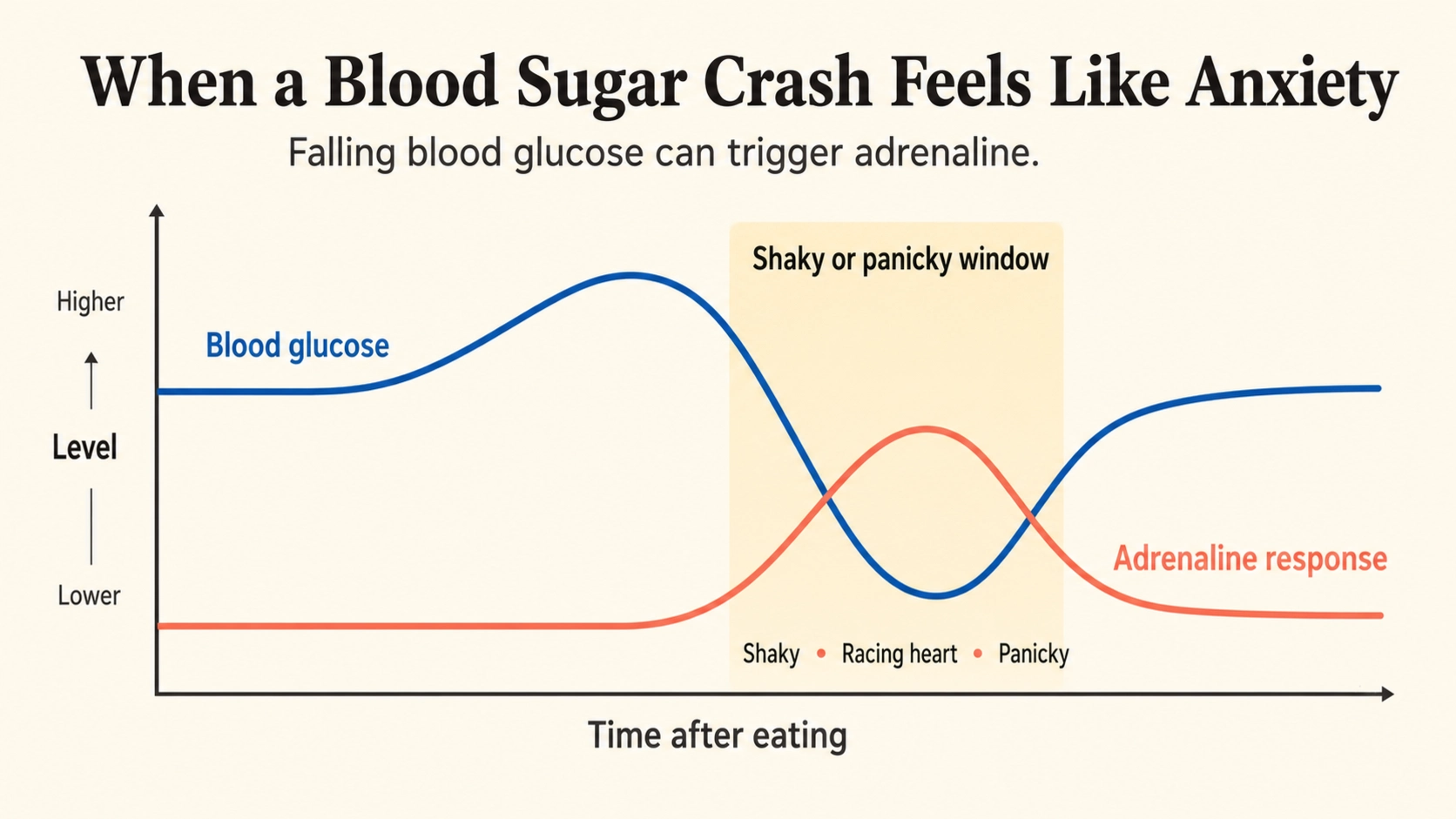
The mechanism is direct. When blood glucose drops quickly, your body treats it as an emergency, because glucose is the brain's primary fuel. It releases adrenaline and cortisol to mobilize stored glucose. Those are the same hormones released during a threat response, and they produce the same physical sensations.
Your body cannot easily tell you the difference between a blood sugar crash and a panic response. Neither can you, in the moment. The physiology overlaps almost completely.
So consider a common pattern. Coffee for breakfast. Nothing until a late lunch, probably carbohydrate-heavy because by then you are ravenous. A sharp crash around three. Something sweet to get through the afternoon. Dinner late, large, and fast.
That pattern produces multiple adrenaline releases per day, unrelated to anything happening in your life. If you are also managing genuine stress, those episodes stack on top of it, and it becomes very difficult to tell which distress is psychological and which is metabolic.
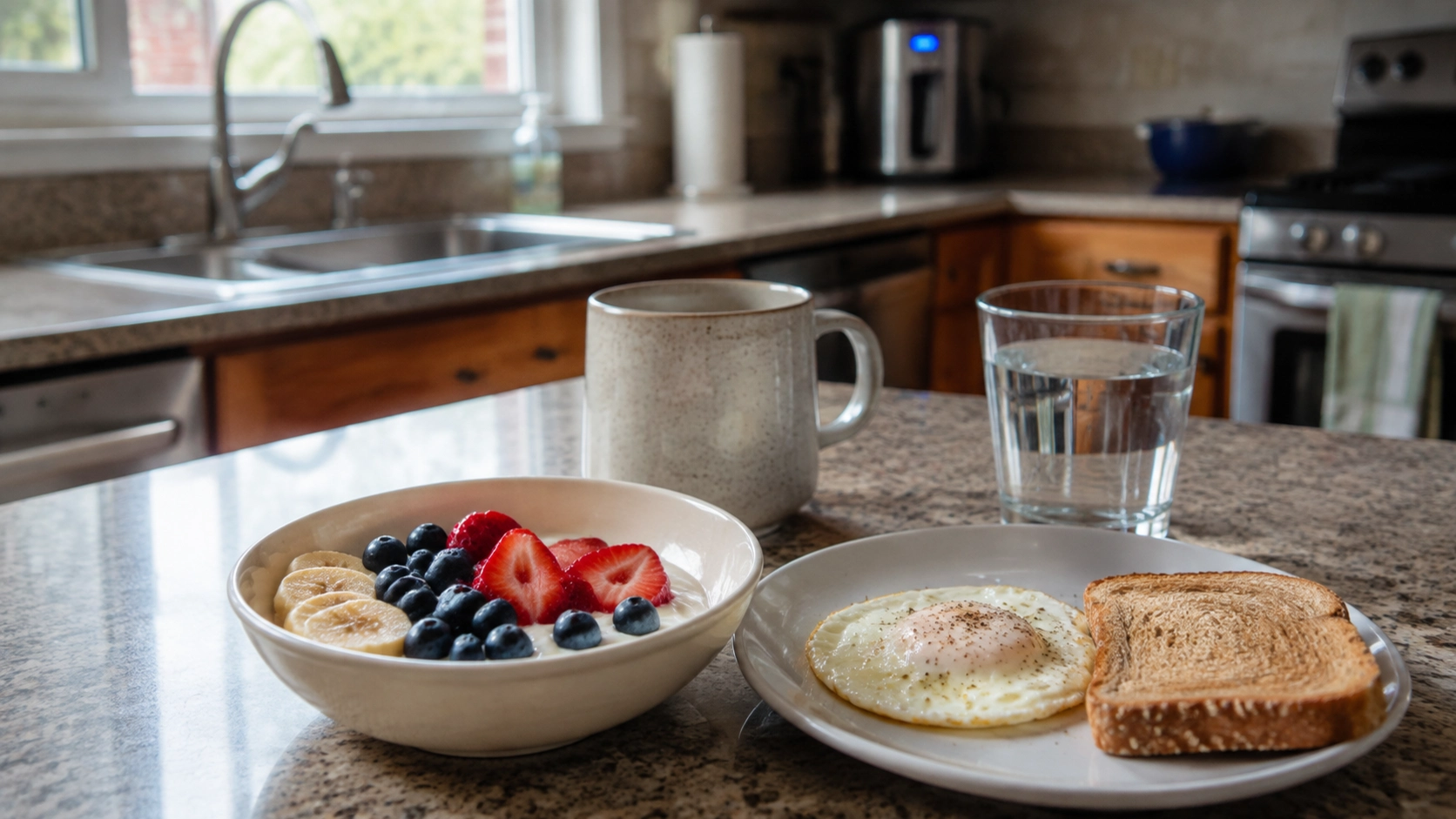
The intervention is not exotic. Eat protein at breakfast. Do not go longer than four or five hours without eating. Pair carbohydrates with protein or fat so glucose enters the bloodstream more gradually. That is most of it.
People frequently report that stabilizing this alone reduces their baseline anxiety noticeably, not because it treated an anxiety disorder, but because it removed several false alarms a day from a system that was already busy.
The Gut-Brain Axis, Carefully
The gut and brain communicate constantly, primarily through the vagus nerve, and traffic runs both directions. Roughly 80 to 90 percent of vagal fibers carry information from the body to the brain rather than the reverse.
Your gut also contains its own extensive neural network and houses the bacterial population known as the microbiome, which produces neurotransmitters and metabolites that influence brain function.
This is real and well established. It is also the most oversold finding in consumer wellness, so here is a careful accounting.
Reasonably solid: gut and brain communicate bidirectionally via the vagus nerve; gut bacteria produce neuroactive compounds; gut inflammation associates with mood symptoms; dietary fiber shapes microbiome composition; gastrointestinal symptoms occur at elevated rates in people with anxiety and depression.
Not solid: that any specific probiotic strain reliably treats anxiety in humans; that you can identify your microbiome composition from symptoms; that consumer microbiome testing produces actionable results; that any commercially available product meaningfully rebuilds gut health.
The honest summary is that the connection is real and the marketing built on top of it is largely ahead of the evidence. What has reasonable support is unglamorous: adequate fiber from varied plants, some fermented foods, and not disrupting the microbiome unnecessarily with antibiotics you do not need.
No product is required for any of that.
Nutrients With Actual Evidence
Four are worth mentioning, with appropriate hedging.
Omega-3 fatty acids. Structural components of neuronal membranes. The evidence for EPA and DHA in depression is among the better-supported findings in nutritional psychiatry, though effect sizes are moderate and results inconsistent across studies. Food sources are fatty fish. If you eat little fish, this is a reasonable gap to address.
Vitamin D. Deficiency is genuinely common in the Northeast, particularly November through March, and correlates with mood symptoms. Whether supplementation improves mood in people who are not deficient is much less clear. A blood test resolves the question, which beats guessing.
Magnesium. Involved in hundreds of enzymatic processes including nervous system function, and intake is below recommended levels for a substantial share of the population. Evidence for supplementation improving anxiety is suggestive rather than conclusive. Food sources are leafy greens, nuts, seeds, and legumes.
B vitamins, particularly B12 and folate. Required for neurotransmitter synthesis. Deficiency produces mood and cognitive symptoms that can look exactly like depression. Worth checking if you eat little or no animal product, take metformin or a proton pump inhibitor, or are over sixty.
The pattern is consistent. Correcting an actual deficiency helps meaningfully.
Some supplements interact with psychiatric medication. St. John's Wort in particular has serious interactions with SSRIs. Tell your prescriber about anything you take.
Alcohol and Caffeine
The two most common inputs, and the two most likely to be quietly driving symptoms.
Alcohol is a depressant that produces rebound activation as it clears. Blood alcohol falls overnight, glutamate rebounds, and sleep architecture fragments in the second half of the night. The result is waking at three or four with the heart going. Next-day anxiety after drinking is a well-described withdrawal phenomenon, not a psychological reaction to anything you said.
For anyone using alcohol to manage anxiety, the arithmetic is bad. Short-term relief purchased with next-day amplification, and rising tolerance requiring more.
Caffeine is a stimulant producing physiological arousal indistinguishable from anxiety, and individual sensitivity varies enormously based on liver enzyme genetics. Some people clear caffeine in three hours; others take more than nine. If you are in the slow group, an afternoon coffee is still active at bedtime.
The experiment worth running, if you drink more than two cups: cut to one, before ten in the morning, for two weeks. Expect two or three unpleasant days. Then assess. Some people find a meaningful portion of what they called anxiety was caffeine.
Where to read further
Two reference points worth reading directly rather than through a wellness intermediary: the National Institute of Mental Health on what is and is not established about diet and mental health, and the Harvard T.H. Chan School of Public Health nutrition source for claims about specific nutrients. If grief is part of what you are managing alongside this, our sister practice Grief Unbound covers how loss shows up in the body.
Can changing my diet cure my anxiety?
No. Diet does not treat an anxiety disorder, and any source telling you otherwise is selling something. What eating patterns can do is remove physiological false alarms, mainly blood sugar crashes, caffeine, and alcohol rebound, that make anxiety harder to manage and harder to distinguish from ordinary stress.
Should I take supplements for anxiety or depression?
Only to correct a deficiency you have actually tested for. Correcting real deficiencies in vitamin D, B12, or omega-3 intake helps meaningfully; supplementing beyond sufficiency generally does not. Ask your physician for bloodwork rather than assembling a regimen from the internet, and tell your prescriber about anything you take, since some supplements interact with psychiatric medication.
Is the gut-brain connection real, or is it marketing?
Both. The connection itself is well established, the gut and brain communicate constantly through the vagus nerve, and gut bacteria produce neuroactive compounds. What is not established is that any specific probiotic, cleanse, or consumer microbiome test does anything useful about it. Fiber from varied plants has support. The products do not.
The Realistic Version
If you are managing anxiety or low mood and want to address the nutritional side, alongside acupuncture or other body-based care, without turning it into another source of pressure, the whole list is short.
Eat protein within an hour or two of waking. Do not go more than about five hours without eating. Get fiber from varied plants. Test rather than guess on vitamin D and B12. Notice honestly what alcohol and caffeine do to you. Do not buy a supplement stack off the internet.
That is it. It will not cure anything. It removes a set of physiological false alarms that make everything else harder, which is a real contribution and not a small one.
One caution worth repeating. If reading this has produced an urge to overhaul everything, restrict something, or start tracking, that impulse is worth examining rather than acting on. Anxiety is very good at reorganizing itself around whatever new system you hand it, and food is a common landing spot. If your relationship with eating is already complicated, this is a conversation to have with a specialist rather than an article to act on.
For everything nutrition cannot reach, that is what the therapy and body-based work here is for.
Melanie takes the discovery calls herself. Fifteen minutes, no charge.
Call (201) 708-8448 or book a free 15-minute call.
Melanie Struble, LCSW, LCADC is the founder and clinical director of the Center for Mind Body Balance in Saddle River, NJ. A licensed clinical social worker and licensed clinical alcohol and drug counselor with more than 33 years in practice, she specializes in addiction, eating disorders, anxiety, and grief. She founded the Center in 2016 to bring licensed therapy and body-based care under one roof, and she still takes every discovery call personally.
Read her full profile · Book a free 15-minute call
This blog post is for informational purposes only and does not constitute professional mental health advice, diagnosis, or treatment.