Introduction
As a licensed clinical social worker and the founder of the Center for Mind Body Balance, I have spent more than two decades watching clients in Bergen County try every reasonable thing for anxiety — medication, therapy, meditation apps, exercise — only to discover that what they actually needed was something that could speak to their nervous system without going through their thinking brain. Acupuncture is one of those things.
Acupuncture for anxiety works through the autonomic nervous system, not through belief. A growing body of research shows it shifts the body out of sympathetic (fight-or-flight) dominance, increases vagal tone, and modulates the HPA stress axis. For Bergen County clients who have plateaued on talk therapy or cannot tolerate the side effects of anti-anxiety medication, it is often the missing piece of an integrative care plan.
How Anxiety Actually Lives in the Body
When most of us talk about anxiety, we describe thoughts: catastrophic scenarios, racing what-ifs, an inability to "turn off the brain." But the thoughts are downstream. Underneath them is a physiological state — a nervous system locked into sympathetic activation, scanning the environment for threat, prioritizing survival over rest.
This is the central insight of modern trauma and anxiety research, and it is why so many people plateau on cognitive approaches alone. As Bessel van der Kolk argues in The Body Keeps the Score, the parts of the brain that hold chronic anxiety — the amygdala, the brainstem, the autonomic nervous system — do not respond to reasoning. They respond to physiological signals of safety or danger. Stephen Porges' polyvagal theory goes further, demonstrating that the felt sense of calm is a state of the vagus nerve, not a state of the mind.
What this means practically: you cannot think your way into a regulated nervous system. You have to reach the nervous system directly.
Why insight isn't enough
A client comes in having done years of cognitive behavioral therapy. They can explain their anxiety with the precision of a clinician. They know where it started, what triggers it, which cognitive distortions feed it. And still — when their boss sends a curt email, their stomach drops, their breath shortens, and they spend the rest of the day in a low-grade panic state.
This is not a failure of therapy. It is a feature of how anxiety is wired. The insight got to the cortex. The anxiety lives below.
This is the gap that body-based interventions are designed to address. We have written about how somatic therapy and talk therapy work on different layers — and how integrating them produces better outcomes than either alone. Acupuncture sits firmly in the body-based column. It is one of the most direct ways to speak to the autonomic nervous system without going through the thinking brain at all.
What Acupuncture for Anxiety Actually Does
For most of its 2,500-year history, acupuncture has been described in the language of meridians, qi, and energetic flow. That framing is real and meaningful within the Traditional Chinese Medicine system that gave acupuncture to the world. But because integrative practices like ours work alongside Western medicine, it is worth understanding what acupuncture is doing in the physiological language Western research has been mapping for the last fifty years.
Vagal tone, the HPA axis, and the parasympathetic shift
Research synthesized by the National Center for Complementary and Integrative Health and across hundreds of peer-reviewed trials suggests acupuncture for anxiety works through several converging mechanisms:
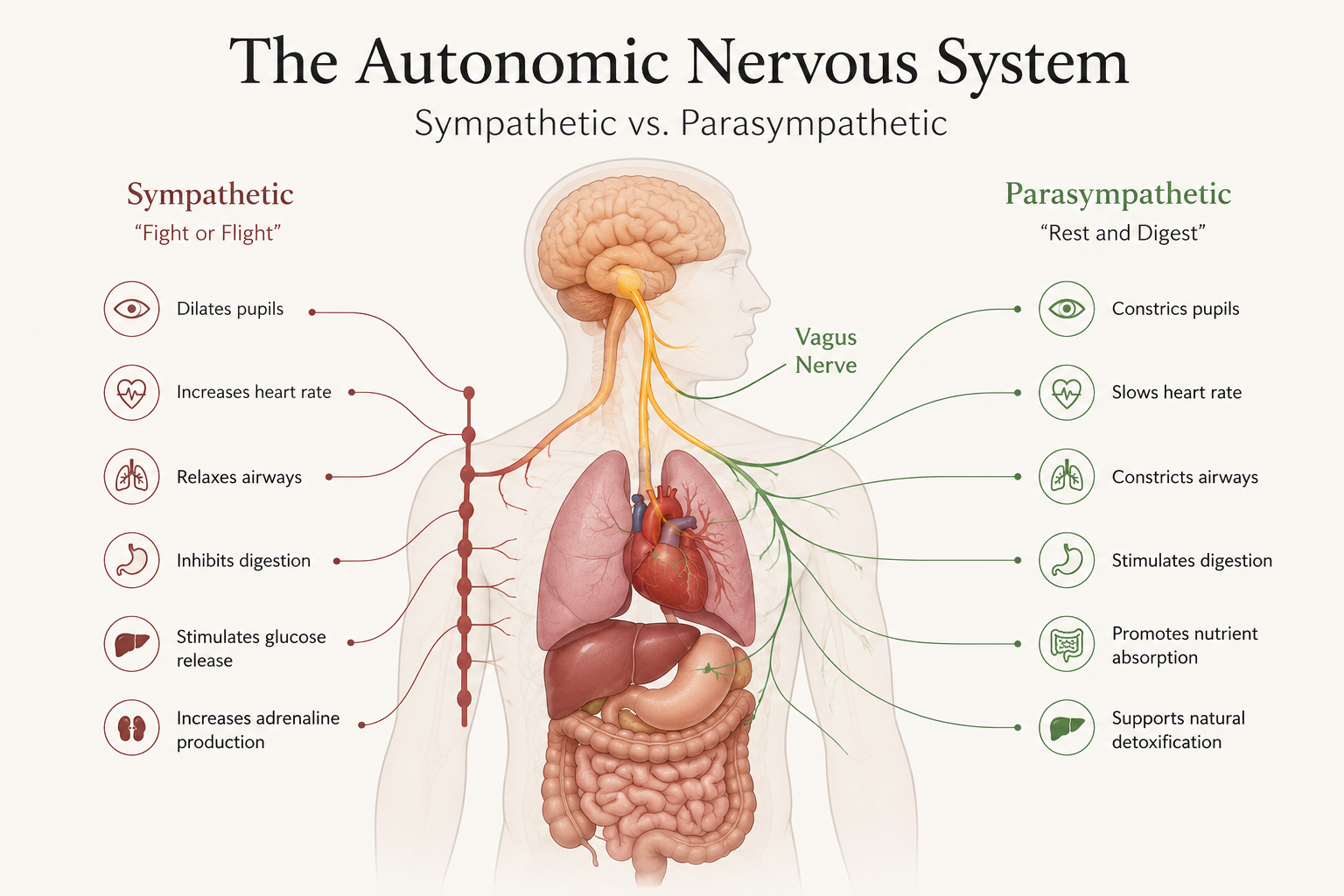
- Vagal tone activation. Specific needle placements appear to stimulate the vagus nerve, the primary pathway of the parasympathetic ("rest and digest") nervous system. Higher vagal tone is associated with greater capacity for emotional regulation, calmer heart rate variability, and reduced anxiety symptoms.
- HPA axis modulation. The hypothalamic-pituitary-adrenal axis is the body's chronic stress system. Studies suggest acupuncture reduces cortisol output and helps re-set HPA reactivity in people whose stress response has become hair-trigger.
- Neurotransmitter shifts. Functional MRI research shows acupuncture influences brain activity in regions involved in emotion regulation — including the amygdala, hippocampus, and prefrontal cortex — and modulates levels of GABA, serotonin, and norepinephrine.
- Local muscle and fascia release. Trigger-point needling reduces the chronic muscular bracing that anxiety produces and reinforces.
What the research actually shows
A growing body of systematic reviews — including work published in the Journal of Acupuncture and Meridian Studies and the BMJ — has found that acupuncture produces significant reductions in anxiety symptoms across multiple controlled trials, with effects comparable to standard anti-anxiety treatments and a markedly lower side-effect profile.
The research is not yet at the level of, say, SSRIs for major depression — partly because controlled trials of acupuncture are methodologically tricky (what exactly is a "placebo needle"?). But the evidence is strong enough that the World Health Organization and major U.S. integrative medicine programs at Johns Hopkins, Mayo Clinic, and Memorial Sloan Kettering now include acupuncture as a recognized anxiety treatment.
Who acupuncture for anxiety helps most
In our experience with clients across Bergen County — Saddle River, Wyckoff, Allendale, Mahwah, and surrounding towns — acupuncture for anxiety tends to be especially valuable for:
- People who have plateaued on talk therapy and want a body-based addition
- People who do not tolerate anti-anxiety medication well, or want to taper off it (always with their prescribing physician's involvement)
- People whose anxiety presents physically — tight chest, gut symptoms, sleep disruption, jaw clenching — more than cognitively
- High-functioning professionals whose nervous systems run hot all day and have lost the ability to downshift in the evening
- People in active burnout who need their physiology brought down before insight will stick
What a Session Looks Like at Our Saddle River Practice
If you have never had acupuncture before, the prospect of being needled while anxious can sound, frankly, counterintuitive. So here is exactly what happens.
Before the first session
We start with a 15-minute discovery call — not an intake form. You tell us what is going on. We listen, ask a few questions, and help you decide whether acupuncture is the right starting point or whether a different modality (or a combination) would serve you better. If we think you should start with a psychologist or a different specialist, we will say so.
The session itself
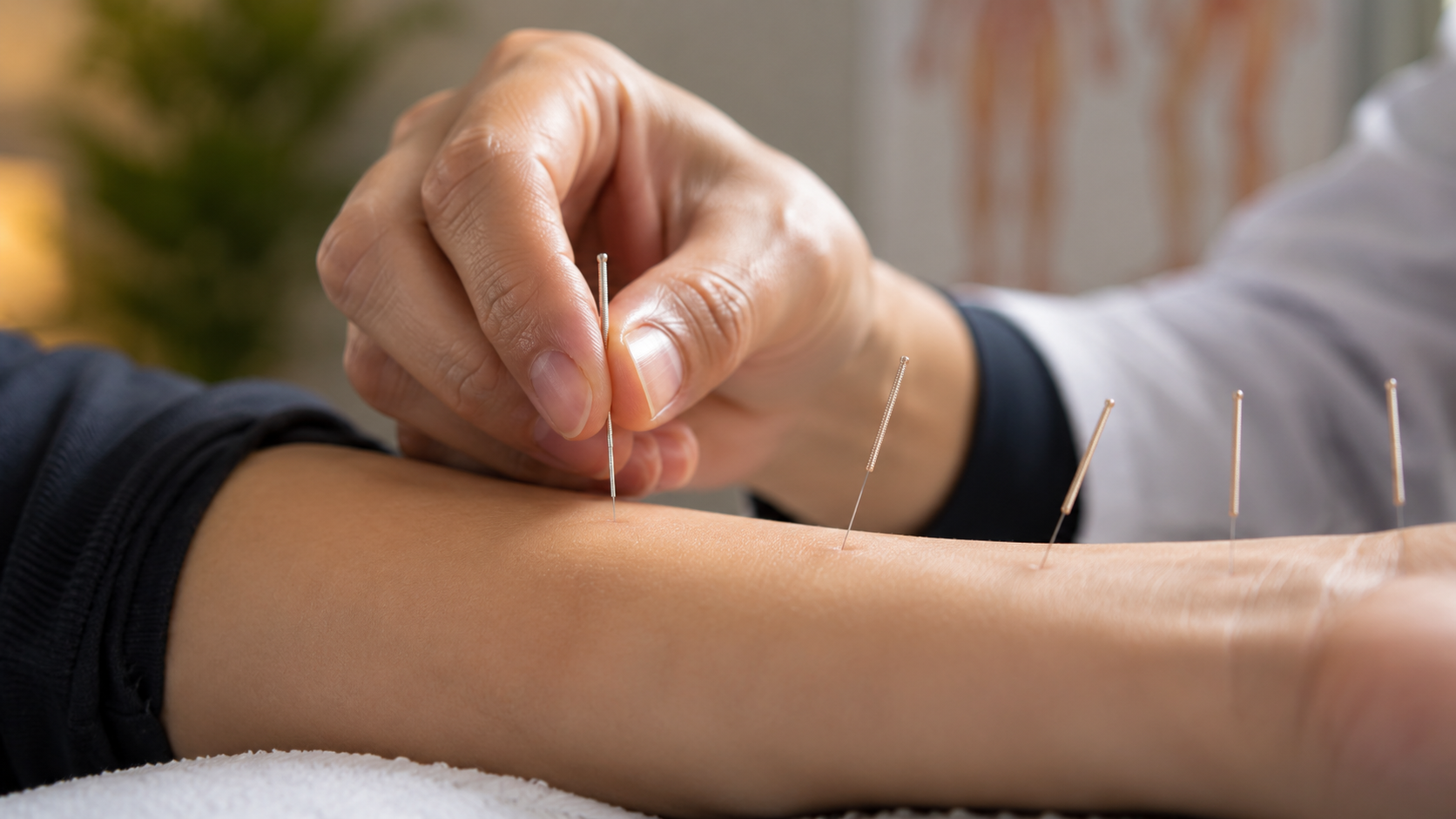
A first acupuncture session typically runs 60 to 75 minutes. About 20 to 30 minutes is conversation — your history, your symptoms, what you are hoping for, what has been tried. The needling itself takes 5 to 10 minutes; then you rest, needles in place, for another 20 to 30. Many people fall asleep.
The needles are roughly the diameter of a human hair — radically smaller than the injection needles most people are imagining. Most insertions feel like nothing. Some feel like a mild pinch that fades within seconds. A handful of points produce a heavy, warm, slightly electric sensation that is actually a sign the treatment is working.
You will likely leave the first session feeling unusually calm, sometimes a little spacey, occasionally a little emotional. We recommend not scheduling anything cognitively demanding for the rest of the day.
How it fits into integrative care
At the Center for Mind Body Balance, acupuncture is rarely the only thing a client is doing. Most of our anxiety clients pair it with psychotherapy, somatic work, breathwork, or our other body-based modalities. The reason is structural: acupuncture creates the physiological room — the regulated state — in which talk therapy and somatic work can actually metabolize.
A typical integrated path:
- Weeks 1 to 4: Acupuncture weekly to bring baseline nervous system arousal down
- Weeks 4 to 12: Continue acupuncture every 1-2 weeks; layer in psychotherapy (often with one of our licensed clinicians ) to do the cognitive and relational work
- Ongoing: Spaced acupuncture (every 2-4 weeks) for maintenance, plus whatever talk or somatic work continues to serve
Because our practitioners share one space — the 1820 building at 96 East Allendale Road — referrals between modalities don't get lost between offices. Your acupuncturist can walk down the hall to introduce you to a clinician. Your therapist can flag what they're noticing to your acupuncturist. The continuity is the medicine.
Frequently Asked Questions
Does acupuncture for anxiety really work, or is it a placebo?
Controlled studies show acupuncture produces anxiety reductions that significantly exceed placebo controls, including studies that use sham needling as a control condition. Mechanism research showing measurable shifts in vagal tone, cortisol, and brain activity makes a pure-placebo explanation increasingly difficult to sustain.
How many sessions before I feel a difference?
Most clients notice something — usually deeper sleep, a calmer baseline, or fewer panic spikes — within 3 to 4 sessions. Sustained change typically requires 8 to 12 sessions, after which most people move to a spaced maintenance schedule.
Is acupuncture safe if I'm on anxiety medication?
Yes. Acupuncture is broadly compatible with anti-anxiety, antidepressant, and most other psychiatric medications. If you want to taper off a medication, that decision must involve your prescribing physician — but acupuncture is often a useful support during a supervised taper.
How to Decide Where to Start
Most people don't know where to begin in an integrative practice — and that's exactly what the free 15-minute discovery call is for. It's not an intake. It's a conversation.
You tell us what's happening. We listen, ask a few questions, and help you figure out the right starting point. If we're not the right fit for what you need, we'll point you somewhere that is.
What to expect on a discovery call:
- 15 minutes, no charge, no commitment required
- A real conversation with Melanie — not an automated form or a front-desk screening
- A plain-language recommendation tailored to your situation
- Honest referrals out if we aren't the right fit
Call (201) 708-8448 or book your free discovery call. Melanie, our founder, answers every call.