Women’s circle reality
Most descriptions of a women's circle are written for people who already attend them. They use language about holding space and sacred containers, which means something specific to the people using it and almost nothing to a woman in Wyckoff wondering whether this is a therapy group, a book club, or something she would find embarrassing.
So: what actually happens in the hour, who it suits, and who it does not.
What happens
The format is simple and the simplicity is the point.
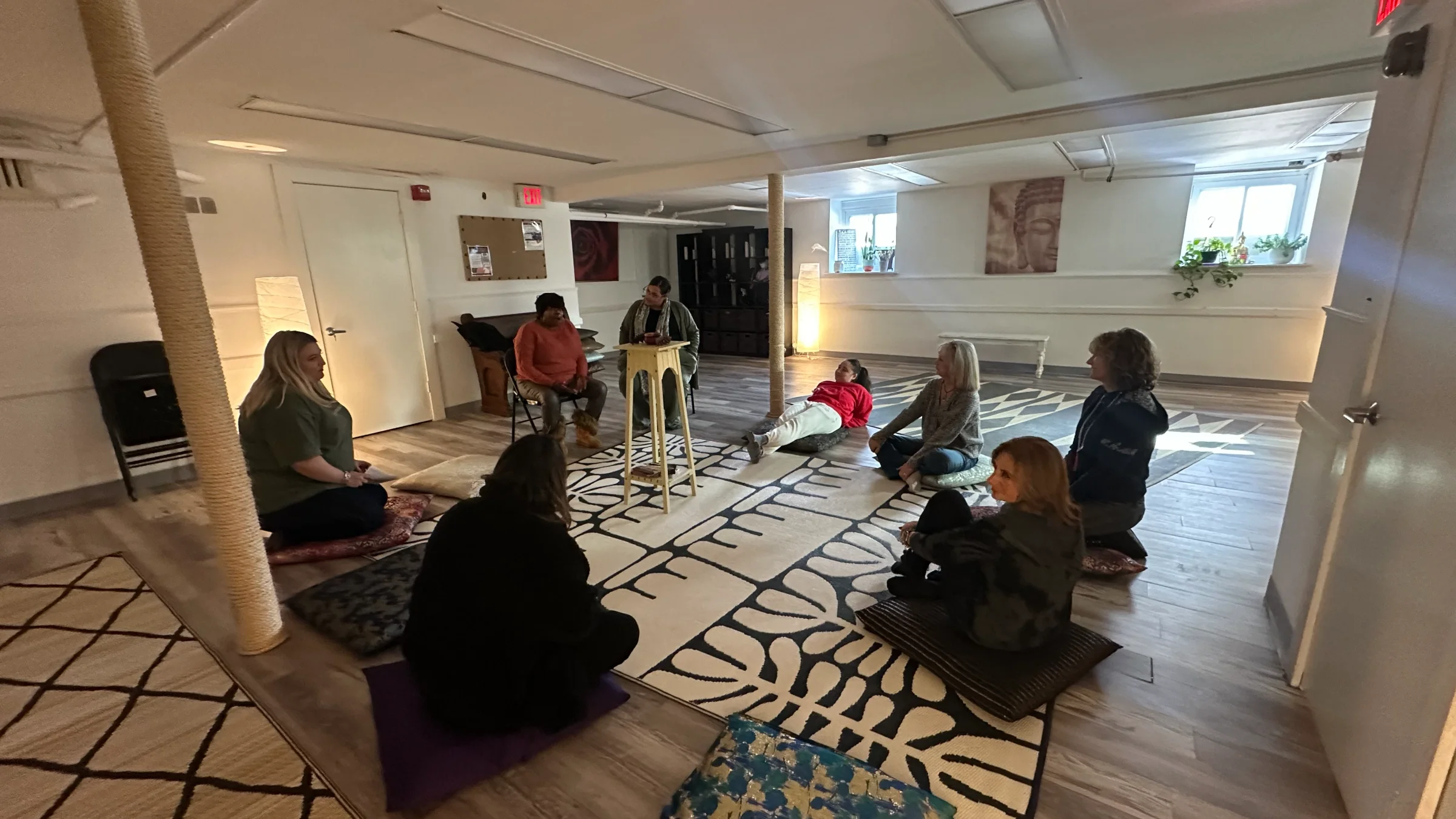
People arrive and sit in a circle, usually eight to twelve of them. A facilitator opens with something short, frequently a few minutes of quiet or a breathing practice, which exists to get everyone out of the day they arrived from. There is then a question or a theme, and the group goes round.
Each person speaks for a few minutes without being interrupted. Nobody responds to what was said. Nobody offers advice, relates it to their own situation, or asks a follow-up question. The next person speaks. There is usually a second, shorter round, and then it closes.
That is the whole thing. It sounds thin written down and it is not, and the reason is the no-response rule.
Why speaking without response does something
Ordinary conversation is a negotiation. You say something, and while you are saying it you are monitoring the other person: are they bored, are they about to offer a solution, is this too much. Most people edit themselves continuously, and most people are also composing their own reply while the other is talking.
Remove the possibility of response and both of those stop. You can say the actual thing rather than the manageable version of it, because nobody is going to do anything with it. Listeners, freed from constructing a reply, actually listen, frequently for the first time in a while.
What people report afterwards is rarely about insight. It is that they said something out loud they had not said to anyone, and nothing bad happened. That is the mechanism, and it is closer to nervous system regulation than to conversation. A body that speaks something difficult in a room that stays calm learns something the thinking mind cannot be argued into.
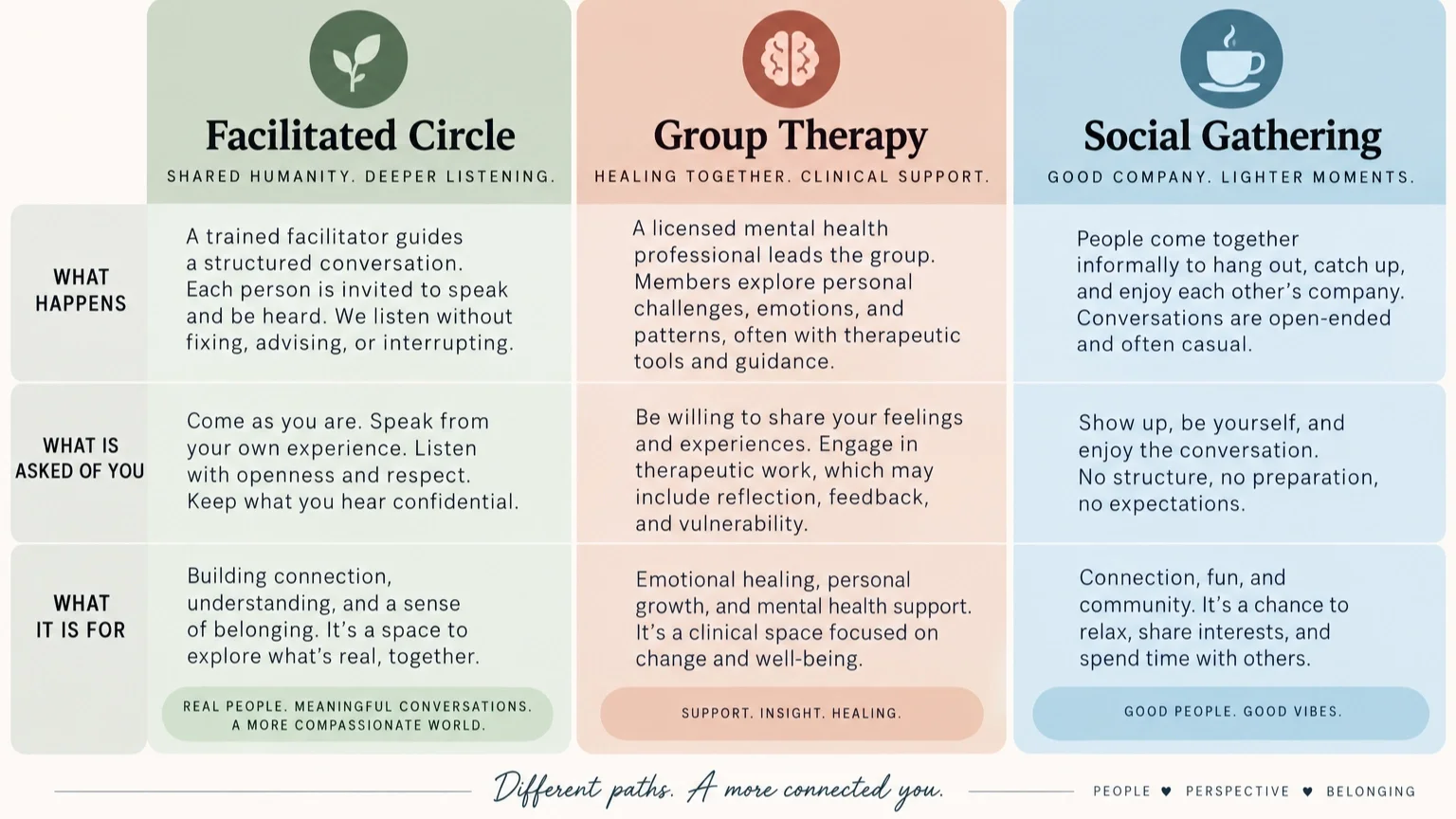
It is not therapy
No treatment plan, no clinical assessment, no working through anything systematically. A facilitator holds the structure rather than intervening. If what you are carrying needs treatment, a circle will not provide it, and a good facilitator will say so. Our post on somatic therapy versus talk therapy covers what clinical work actually involves.
It is not a support group
Support groups usually gather around a shared specific: a diagnosis, a loss, a circumstance. A circle is not organized around a problem and people arrive with entirely different things. Where a shared specific is what you need, a dedicated group is better, and the same is true of body-based group work such as a sound bath, which does something different again. Our sister practice, Grief Unbound, runs bereavement groups on that model.
It is not a social event
There is no mingling requirement, no small talk, and you do not need to arrive with anything to say. People frequently attend for months without socializing outside it, which is entirely normal.
Who it suits
- Women in a transition. A move, a divorce, an empty house, a career change, a diagnosis, or the hormonal shift we describe in our post on perimenopause and the nervous system , which reliably arrives alongside an identity change that has no obvious name. Transitions are isolating largely because they are difficult to describe in passing.
- Women with plenty of people and very little contact. A common and rarely admitted position. Busy, surrounded, and not actually known by anyone currently.
- Women who are the one everyone else relies on. People who spend their lives listening frequently find that being on the other side of it is disproportionately affecting.
- Women who find one-to-one attention too much. A circle is considerably less exposing than an hour of a therapist looking at you.
- Women already in therapy who want community alongside it. These combine well. They do different jobs.
Who it suits less: anyone in acute crisis, who needs individual clinical attention first, and anyone hoping for a discussion, since the structure specifically prevents that and people who want debate tend to find it frustrating.
The things people are actually worried about
Almost everyone hesitating is hesitating about one of four things.
- Having to speak. You do not. Pass is a complete answer and it is used regularly, including by people who have attended for a year.
- Not being spiritual enough. The format requires no belief in anything. If a particular circle feels heavier on that dimension than suits you, that is a question of fit rather than a verdict on you.
- Crying. Common, unremarkable, and nobody will make it a thing.
- Confidentiality. Bergen County is small and this is a legitimate concern. Ask directly how it is handled before you attend. Any facilitator who cannot answer clearly is one to avoid.
Why this is more needed than it used to be
It is worth naming the reason these have proliferated, because it is not fashion. Adult friendship has become structurally harder to maintain. People move more, work longer, live further from where they grew up, and conduct a great deal of their contact through screens that produce the appearance of connection without much of its substance.
The consequence is a specific and widely shared position: knowing a great many people and being known by very few. The Office of the Surgeon General issued an advisory on loneliness and social isolation identifying it as a significant public health concern, with physical health effects comparable to well-established risk factors. That is a striking claim and it is well evidenced, and the Centers for Disease Control and Prevention has since published its own guidance treating social connection as a health measure rather than a lifestyle preference.
A circle does not fix that on its own. What it does provide is one hour a fortnight in which you are known accurately by a small number of people, which for a meaningful number of adults is one hour more than they currently have.
What people say afterwards
Two responses come up repeatedly, and both are worth knowing in advance because they are not what people expect.
The first is relief at how little was required. People arrive braced for something performative and find a structure that asks almost nothing. The second is surprise at the effect of listening. Most people assume the value is in speaking, and a large number report that hearing someone else articulate something they had not managed to put into words themselves was the more useful half.
What people rarely report is transformation, and any description promising it is overselling. The honest account is that it is one steady hour that makes the rest of the fortnight slightly more manageable, and that the effect is cumulative rather than immediate.
Frequently Asked Questions
What do I bring?
Nothing. Layers are worth having, since people cool down when they settle.
Do I have to commit to a series?
Depends on the format, and both models exist. Drop-in is easier to try. A closed series builds more, because the group knows each other by the third session and people go deeper.
Is there anything similar for men?
The same structure works and is considerably rarer, which is a real gap. Worth asking us about, since demand rather than principle is what determines whether one runs.
Ask Us Where to Start

If you have read this far you are probably deciding whether to try one, and the honest answer is that no description substitutes for sitting in it once.
The free 15 minute call will tell you whether a circle, a group, or individual work is the better starting point. It is a conversation, not an intake, and there is no obligation attached to it.
Call (201) 708-8448 or book your free discovery call. Melanie, our founder, answers every call.
This blog post is for informational purposes only and does not constitute professional mental health advice, diagnosis, or treatment.