People who have decided to try sound healing usually get stuck on the next question, which is which version to book. The websites tend not to help, because they describe both in the same language.
They are genuinely different, and the difference matters more than most people expect. If you want the full walkthrough of what happens in a session, our beginner’s guide to your first sound healing session covers that. This post is only about choosing between the two.
What is the same
The instruments and the mechanism do not change. Tibetan and crystal singing bowls, gongs, chimes, and tuning forks, played in sustained patterns. You lie down, fully clothed, on a mat or a table. Nothing is asked of you.
The effect works through acoustic entrainment, which is the tendency of the brain to synchronize to consistent external rhythms, alongside the direct physical effect of low-frequency vibration on the chest and abdomen. Neither of those requires you to believe anything. We set out the mechanism in more detail, alongside how it differs from reiki, in our post on reiki versus sound healing.
What changes in a group
A group sound bath runs roughly 45 to 60 minutes with anywhere from six to twenty people in the room, each on their own mat.
The obvious difference is cost, and it is substantial enough that it is the deciding factor for many people. The less obvious difference is that a room of people all doing the same still thing has an effect of its own. Nervous systems are responsive to the state of the nervous systems around them, and settling is contagious in a way that is easy to underestimate until you have been in the room.
There is also a lower barrier to walking in. You are one of a number of people, nobody is watching you, and you can leave without having had a conversation about it. For anyone whose hesitation is really about being observed, a group is considerably easier than an hour of one-to-one attention.
The tradeoffs are real. You get whatever sequence is being played rather than something aimed at you. The room may be warmer or colder than you would like, someone may cough, and the timing is fixed. And if something surfaces emotionally, which it does for a meaningful number of people, you are processing it in company.
What changes in a private session
A private session runs 45 to 75 minutes with one practitioner and you.
The main difference is that it can be aimed. You say at the start what you are carrying, and the practitioner shapes the session around it: instrument placement, which frequencies get emphasis, how long is spent where, whether bowls are placed on or near the body. People consistently report going deeper, partly because of the tailoring and partly because there is nothing else in the room to attend to.
It is also the appropriate choice when what you are bringing is not something you want to be in public with. Grief in particular. If there is a real chance you will cry, and for people in the first year after a loss there frequently is, a private room is kinder than a mat between two strangers.
The tradeoffs are cost, and for some people the intensity of one-to-one attention, which a minority find harder rather than easier.
Side by side
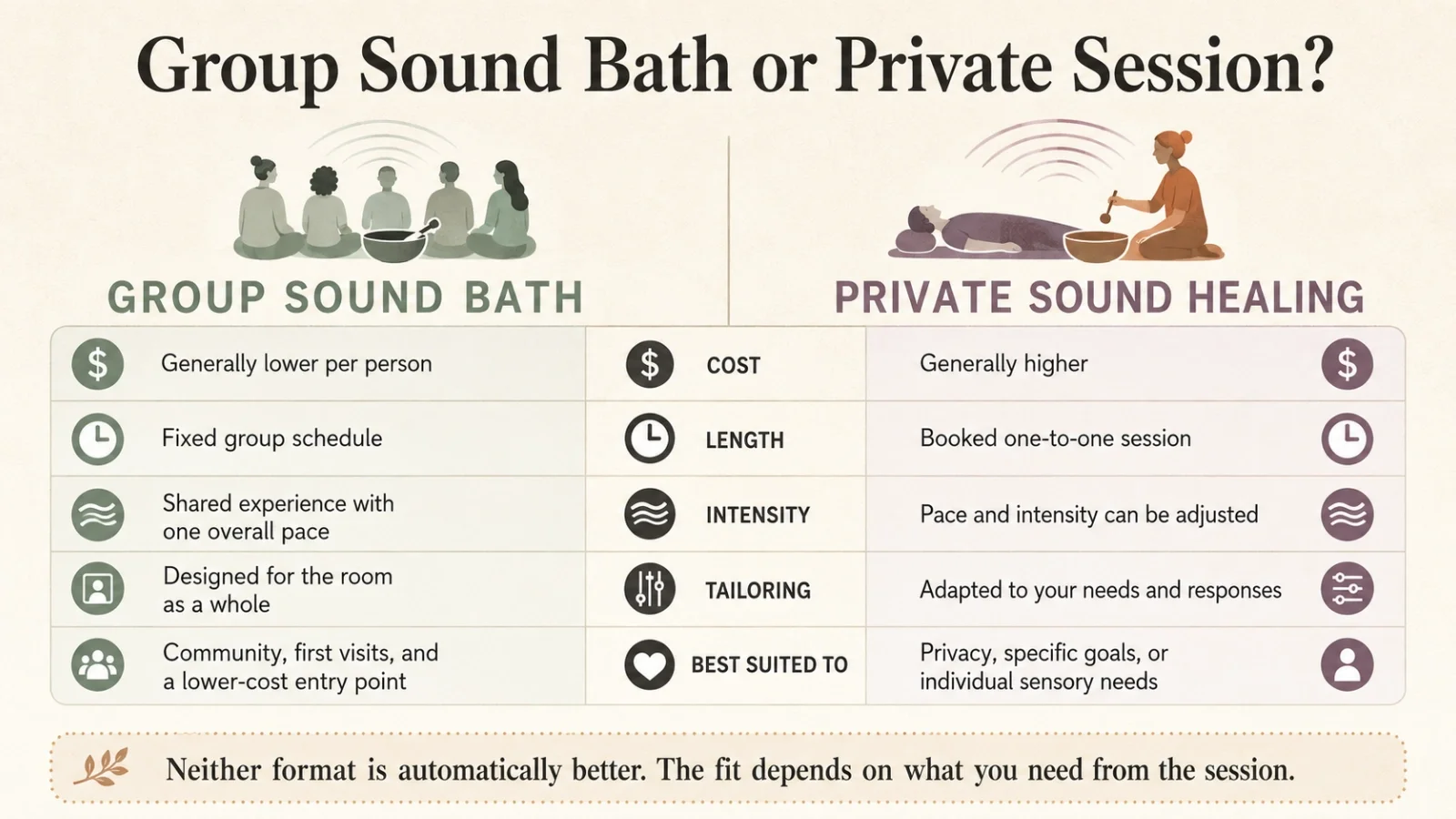
- Length. Group: 45 to 60 minutes. Private: 45 to 75 minutes.
- Cost. Group: considerably lower per session. Private: higher, and correspondingly harder to do weekly.
- Tailoring. Group: none, you receive the sequence being played. Private: shaped around what you bring.
- Depth. Group: reliably settling. Private: typically deeper, with more emotional material surfacing.
- Privacy. Group: you are among people. Private: entirely private.
- Best first booking for. Group: curiosity, stress, sleep, general depletion, anyone nervous about committing. Private: grief, trauma, a specific issue, or anyone who would rather not do this in company.
How most people actually use them
The common pattern is a group session first, because it is the lowest-commitment way to find out whether this does anything for you. A meaningful number of people discover it does considerably more than they expected, and move to a private session when something specific surfaces that they want to work with directly.
From there it tends to settle into groups as ongoing maintenance, roughly the way someone else uses a weekly exercise class, with private sessions when there is a particular reason. There is no correct sequence, and plenty of people only ever do one or the other.
What sound healing is not is a treatment for a clinical condition. Where trauma, depression, addiction, or acute symptoms are part of the picture, this is a useful component of a plan rather than the plan. A practitioner who tells you otherwise is one to be careful of.
What the research actually supports
Worth being accurate here, because this is a field with a great deal of overclaiming in it. What is reasonably well supported is that sustained low-frequency sound shifts brainwave activity toward alpha and theta ranges, the states associated with deep rest and the edge of sleep, and that participants in singing bowl sessions show measurable reductions in tension and improvements in heart rate variability relative to controls. The National Center for Complementary and Integrative Health maintains plain summaries of where the evidence sits across this category generally, and the underlying mechanism is consistent with the polyvagal framework developed by Stephen Porges, which holds that a felt sense of safety is a physiological state shaped by sensory input rather than a decision.
What is not supported is anything about specific frequencies healing specific organs, tuning your cells, or repairing DNA. You will encounter all of it. None of it is necessary for the thing to work, and a practitioner who leans on it is telling you something about their judgment.
The honest position is that this is a reliable way to reach a deeply rested state, that the state itself has real physiological value, and that it is not a treatment for a medical or psychiatric condition. That is a smaller claim than the industry tends to make and it is the one that holds up.
Cost, frequency and how to think about it
Groups are priced to be repeatable, which is the point of them. If you are considering this as something ongoing rather than a one-off, the group rate is what makes weekly or fortnightly attendance realistic, and regularity does more than intensity in this particular practice.
Private sessions are priced as one-to-one clinical time and are generally used more sparingly: a course of a few sessions around something specific, or occasional maintenance. A reasonable pattern for many people is groups as the habit and a private session when there is a reason.
Frequently Asked Questions
What if I fall asleep?
Extremely common and completely fine. The state most people drift into sits between waking and sleep, and crossing fully over does not mean you missed it. Nobody will wake you and nobody minds.
Do I need to bring anything to a group session?
Layers, mainly. Body temperature drops when the nervous system settles, so people who were comfortable at the start are frequently cold by the middle. Mats and blankets are provided.
Is a sound bath appropriate if I am grieving?
Yes, and many people find it reaches what talking does not. The only caution is choosing the format thoughtfully, since grief surfaces readily under sound. Our sister practice, Grief Unbound, operates in the same building and covers the wider picture of how loss lives in the body.
Ask Us Where to Start
If you are not sure which to book, the free 15 minute discovery call will sort it in about five minutes. It is a conversation, not an intake.
You tell us what is going on and what you are hoping for. We suggest a starting point, and if a sound bath is not really what you need, we will say so and point you at whatever is.
Call (201) 708-8448 or book your free discovery call. Melanie, our founder, answers every call.
This blog post is for informational purposes only and does not constitute professional mental health advice, diagnosis, or treatment.