Introduction
As a licensed clinical social worker who has spent more than 33 years working with people whose bodies hold what their words cannot reach, I have watched a specific thing happen over and over. Someone tries yoga because everyone says it will help. They leave the class more wound up than they went in. They conclude they are bad at yoga.
Usually they are not bad at yoga. They are in the wrong format.
Somatic yoga and conventional yoga look superficially similar and work in opposite directions. Understanding that difference is often what turns movement from something a person endures into something that actually settles them.
The Class That Looks Like Nothing Is Happening
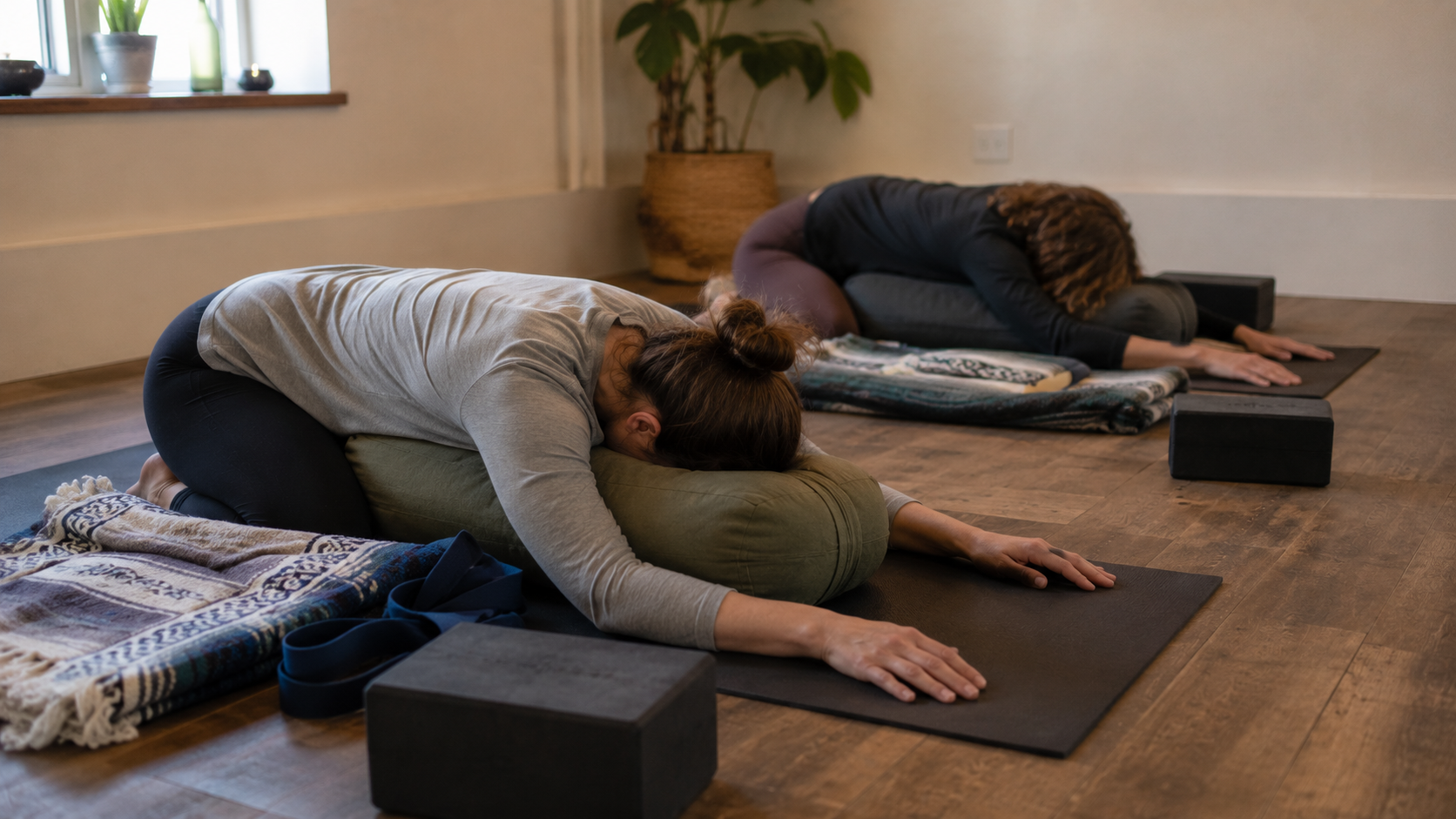
If you walked past a somatic yoga class and glanced in, you might think you had caught everyone mid-rest.
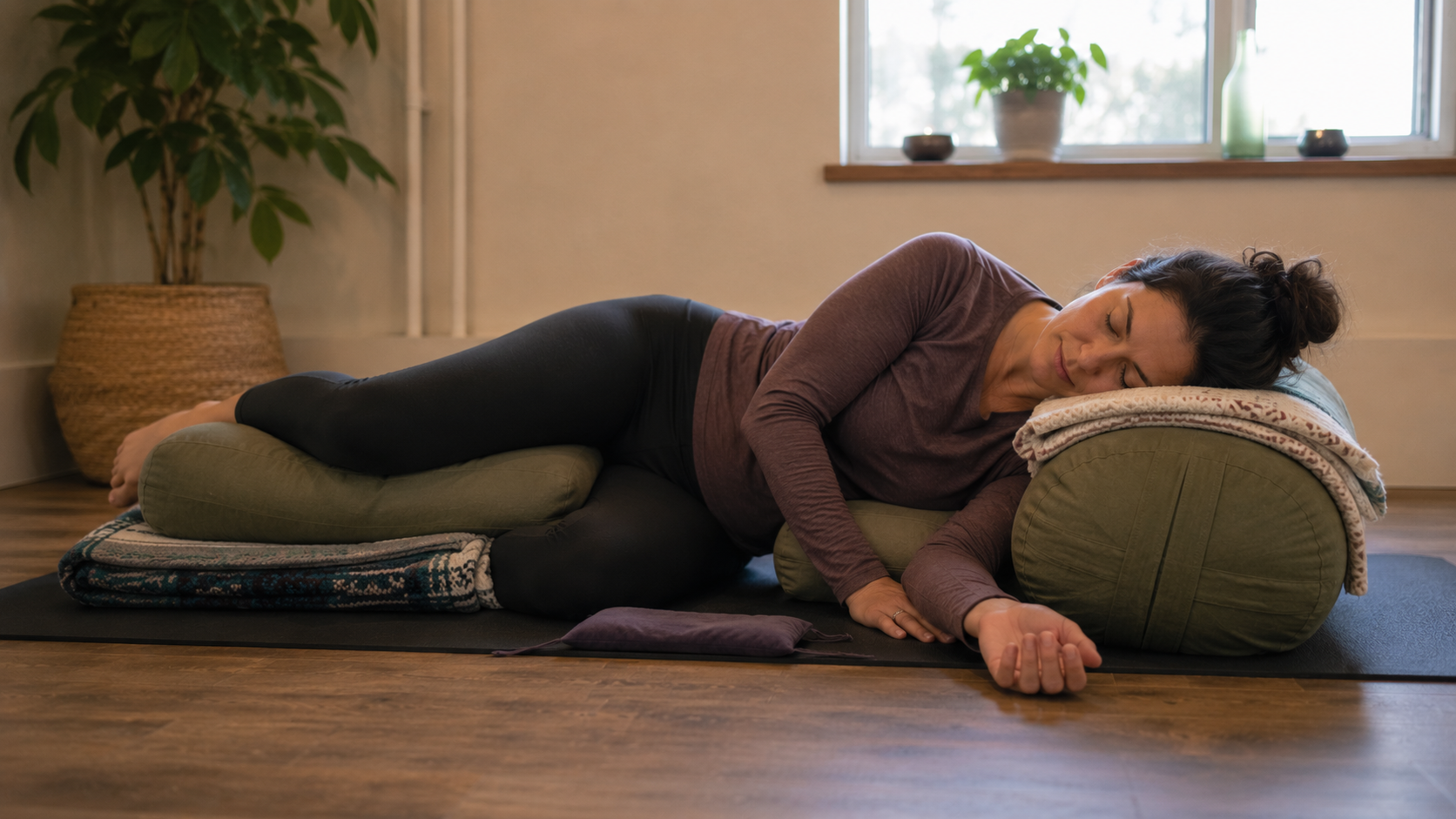
People are on the floor. Nobody is upside down. Someone is moving one shoulder forward and back, maybe an inch, over and over, with real concentration. Someone else has been lying on their side for four minutes and has not visibly done anything at all.
From outside, it looks like the least productive hour in the building. From inside, it is often the hardest class we offer.
That gap is worth explaining, because most people arrive at somatic work after something else stopped working. They tried a vinyasa class and left more activated than they went in. They have a lower back that flares no matter how carefully they move. They found that a certain hip opener made them cry in a way that had nothing to do with the stretch.
If any of that is familiar, the difference between somatic yoga and the yoga you know is not intensity. It is direction.
Regular Yoga Works From the Outside In
Most yoga taught in Bergen County, and most yoga taught anywhere, is asana practice. There is a form. A teacher describes it, and you organize your body toward it.
This is a genuinely good system, refined over a very long time. The forms carry information. Working toward a shape teaches you things about your body you would not learn wandering around freely, and the discipline of meeting a standard has value in itself.
But the mechanism is worth naming. The reference point is external. The pose exists independently of you, and your job is to close the distance between where your body is and where the pose is.
For many people this works beautifully. They get stronger, sleep better, and develop a relationship with their body built on the honest feedback of trying something difficult.
For some people it does not, and the reasons are instructive.
If your nervous system is already running hot, an external reference point gives it one more thing to perform against. Part of your attention is on the pose, part on the teacher, part on the person to your left who is clearly finding this easier. The class becomes another arena for the same vigilance you walked in with.
If you have a trauma history, the problem can be sharper. Being directed into a specific configuration, sometimes with hands-on adjustment, sometimes in a position where you cannot see the room, can register in the body as something other than instruction. Not because the teacher did anything wrong. Because the nervous system reads context faster than the thinking mind can override it.
And if you have chronic pain, working toward an external shape can quietly reinforce the holding pattern that produced the pain. You get into the pose by recruiting whatever is available, which is usually the same overworked muscles running the same compensations they have run for a decade.
What Somatic Yoga Asks You to Do Instead
Somatic yoga reverses the direction of attention. There is no pose you are trying to reach. There is a movement, usually small and slow, and the assignment is to notice what happens inside you while you do it.
That sounds soft. It is not. Most people find it genuinely disorienting at first, because the question has no practice behind it.
A teacher might say: lift your right shoulder toward your ear, slowly, and stop the moment it stops being easy. Then come back down more slowly than you went up.
There is no correct height. No held count. The instruction contains no standard to meet or fail. The only information that matters is what you noticed — and most people's first honest answer is that they noticed almost nothing, or that they cannot tell where their shoulder is without looking.
That is not failure. That is the actual starting condition for a great many people, and it is what the practice exists to address.
Interoception: the thing being trained
The technical term for this sense is interoception, the perception of your body's internal state. It is real, measurable, and varies enormously between people. It tends to be lower in people with chronic pain, chronic stress, and trauma histories.
When interoception is low, you often do not register that you are tense until the tension has become pain, or that you are activated until you are already in a full stress response.
Somatic movement trains that channel directly. The movements are small because small movements produce quiet signals, and learning to hear quiet signals is the entire skill. Move fast and large and the sensation is loud enough that no perception is required. Moving an inch at a time forces the system to listen.
Pandiculation: why this loosens what stretching didn't
The second mechanism explains why somatic work can release things stretching never touched.
When you stretch a chronically tight muscle, you are pulling on a muscle your nervous system has decided to hold. It is not tight because it is short. It is tight because it is receiving a standing order to contract — usually issued years ago in response to an injury, a posture, or a stretch of sustained stress, and never rescinded.
Stretching pulls against the order. The nervous system, protecting you, often pulls back harder. This is why some people stretch a hamstring daily for years and it is exactly as tight on day two thousand as on day one.
Pandiculation works differently. You voluntarily contract the muscle that is already holding, tightening it further, then release slowly with full attention. That sequence gives the nervous system new information about the muscle's actual length and current state. It is closer to rebooting a stuck process than forcing a door.
You have done this without knowing. It is what a cat does on waking. It is what you do when you yawn and your arms extend overhead without you deciding. Somatic practice makes it deliberate.
Why this sits alongside therapy
Slow movement with sustained internal attention, in an environment where nothing is demanded of you, is one of the more reliable ways to shift the autonomic nervous system out of sympathetic activation.
Talking about calming down does not reliably move that system — it is not primarily responsive to language. It responds to signals of safety delivered through the body.
This is the same logic behind breathwork and behind somatic therapy, which is why the three combine well. They approach one system through different doors.
It is also why people sometimes have unexpectedly large emotional responses in somatic classes. When a chronic holding pattern releases, whatever the holding was managing tends to become perceptible. This is normal, it is not dangerous, and it is a good reason to do this work somewhere a clinician is in the building.
Who Each One Serves Best
Not a hierarchy. Different jobs.
Conventional yoga tends to serve you well if you want strength and mobility, you enjoy working toward something, you are not in significant pain, you find group energy motivating, and your nervous system is basically regulated even when life is not.
Somatic yoga tends to serve you better if you have chronic pain or tension that has not responded to stretching, you have left conventional classes more activated than you arrived, you have a trauma history, you have limited mobility or an injury that makes conventional classes inaccessible, you have trouble telling what you are feeling in your body, or you are already in therapy and want a movement practice on the same track.
Many people do both, and order matters. Somatic work first to build sensing capacity, then conventional practice with that capacity intact. People who take that route often report their conventional practice changes completely, because they can finally feel what they are doing rather than approximating it visually.
What a Class Here Looks Like
Small. Floor-based for most of the hour. Bolsters, blankets, and blocks available and actively encouraged rather than treated as a concession.
Slow to a degree that surprises people. A single movement sequence might take ten minutes.
No hands-on adjustment without asking first — every time, not once at intake.
No mirrors, and no expectation about whether your eyes are open or closed. You choose, and you can change your mind mid-class.
Frequent invitations to stop, rest, or do less. In a conventional class, resting is a fallback. Here it has the same standing as anything else, because a nervous system does not benefit from being pushed through resistance.
You will likely leave feeling something you may not have a word for. Not the clean lift of a hard workout. More like having set down a bag you did not know you were carrying, which usually arrives as relief mixed with mild fatigue.
Classes run in the 1820 building at 96 East Allendale Road — originally the Zion Evangelical Lutheran Church, and the oldest surviving church building in Bergen County. Thick walls, real doors, and rooms built to hold quiet.
Frequently Asked Questions
Is somatic yoga a workout?
No, and it is not trying to be. You will not build strength or cardiovascular fitness in a somatic class. What you build is the ability to sense your own body accurately, which is a different capacity with different uses. Many people pair somatic work with strength training or conventional yoga rather than substituting one for the other.
Can I do somatic yoga with an injury or limited mobility?
Usually yes, and it is often more accessible than conventional yoga for exactly that reason. Movements are small, floor-based, and fully supportable with props, and there is no shape you are failing to reach. Tell the instructor before class what is going on. If you have an acute or undiagnosed injury, see your physician first — somatic work is not a substitute for diagnosis.
What's the difference between somatic yoga and somatic therapy?
Somatic yoga is a movement class. Somatic therapy is clinical treatment with a licensed clinician, working with your specific history. They share a premise about how the body holds experience, and they work well together, but a class is not therapy and should not be presented as one.
If You've Decided You're Bad at Yoga
That conclusion is worth revisiting, because it is usually a verdict on a format rather than on a person.
Leaving a class more wound up than you went in is information. So is a back that flares no matter how carefully you move, or a stretch that produced an emotional response out of proportion to the stretch. None of that means you lack discipline or body awareness. It usually means the format asked you to perform at a moment when your nervous system needed the opposite.
A few honest caveats before you book anything. If you are in acute pain, start with your physician — somatic work is not a substitute for diagnosis, and undiagnosed pain deserves diagnosis. If you are in active trauma treatment, mention this to your therapist first. Most will be glad you asked; some will want to time it around where you are in the work.
And if what you actually want is to get stronger, a somatic class is the wrong room. We will tell you that rather than sell you a package.
If you want to talk it through, Melanie takes the discovery calls herself. Fifteen minutes, no charge. Tell her what happened the last time you tried, and she will tell you whether this format is likely to be different — or point you to somewhere that fits better.
Call (201) 708-8448 or book a free 15-minute call. You can also see the current class schedule.
About the author
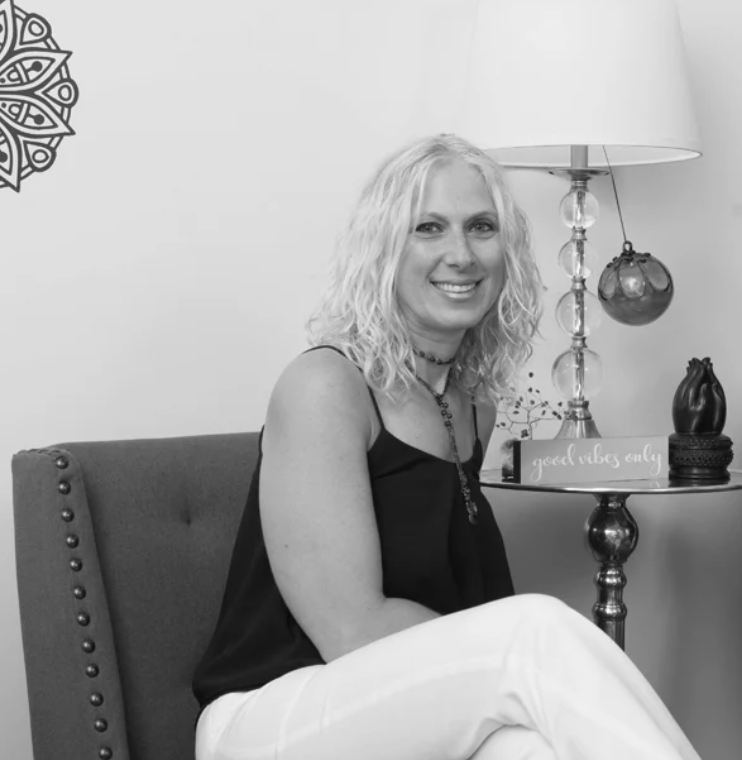
Melanie Struble, LCSW, LCADC is the founder and clinical director of the Center for Mind Body Balance in Saddle River, NJ. A licensed clinical social worker and licensed clinical alcohol and drug counselor with more than 33 years in practice, she specializes in addiction, eating disorders, anxiety, and grief. She founded the Center in 2016 to bring licensed therapy and body-based care under one roof, and she still takes every discovery call personally.
Read her full profile · Book a free 15-minute call