
When people call about eating disorder support in Bergen County, one of the first questions is usually some version of: am I bad enough for this.
It is asked apologetically, and almost always by someone who has been struggling for years.
There is no threshold to cross. This post explains what weight-neutral care actually means, who is involved in it, what the first appointment is like, and how to start, whether you are calling for yourself or for someone you love.
What weight-neutral care means
Weight-neutral care means that weight is not used as the goal, the measure of progress, or the reason for treatment. The work is on the relationship with food, with the body, and with the thinking that has organized itself around both.
This is not a fringe position. It is the same principle behind Health at Every Size, and it reflects where the clinical field has moved, for a straightforward reason: setting a weight target in eating disorder treatment tends to reinforce the exact mechanism the disorder runs on.
A person whose difficulty is that a number has been given authority over their day does not recover by being given a different number to pursue. That is the core of weight-neutral eating disorder treatment, and it is why the approach looks so different from anything sold as a diet.
What weight-neutral care does not mean is that physical health is ignored. Medical monitoring happens where it is needed, and a good team will tell you plainly when what you are describing needs a level of care beyond outpatient support.
It means that health is assessed by how a person is actually functioning rather than by where they sit on a chart.
In practice, this changes the questions. Instead of asking what you weigh, we ask how much room food and body image thoughts are taking up in your day. Whether you can eat with other people. Whether you are avoiding things you used to enjoy. Whether the rules have got more numerous over time.
Those answers say considerably more about what is happening than any measurement does.
Who this affects, which is more people than the stereotype suggests
The picture most people carry is a teenage girl who is visibly underweight. That picture describes a minority of cases and it keeps a great many people from seeking help, because they compare themselves to it and conclude they do not qualify.
In reality, eating disorders occur across every age, gender, body size and background.
- Men are affected and are significantly less likely to be identified or to seek support.
- People in larger bodies are affected and are frequently praised for behaviors that would be treated as symptoms in a smaller body. Binge eating is the most common eating disorder in the United States and the least likely to be recognized as one.
- Adults in midlife are affected, often having managed something for decades that intensified around a life transition, a loss, a health diagnosis or a change in circumstances. Eating disorders in midlife are far more common than the stereotype allows.
The National Alliance for Eating Disorders maintains a national helpline staffed by licensed clinicians and is a useful resource whether or not you decide to work with anyone locally.
One further pattern is worth naming, because it brings a steady number of people to us: an eating difficulty that had been manageable for years intensifying sharply after a loss. Food is one of the few things a person can still control when everything else has been rearranged without their consent, and grief is exhausting in a way that makes rigid rules feel like relief. If that describes the timing for you, our sister practice Grief Unbound works in the same building, and the two pieces of work run better together than separately.
What care actually involves
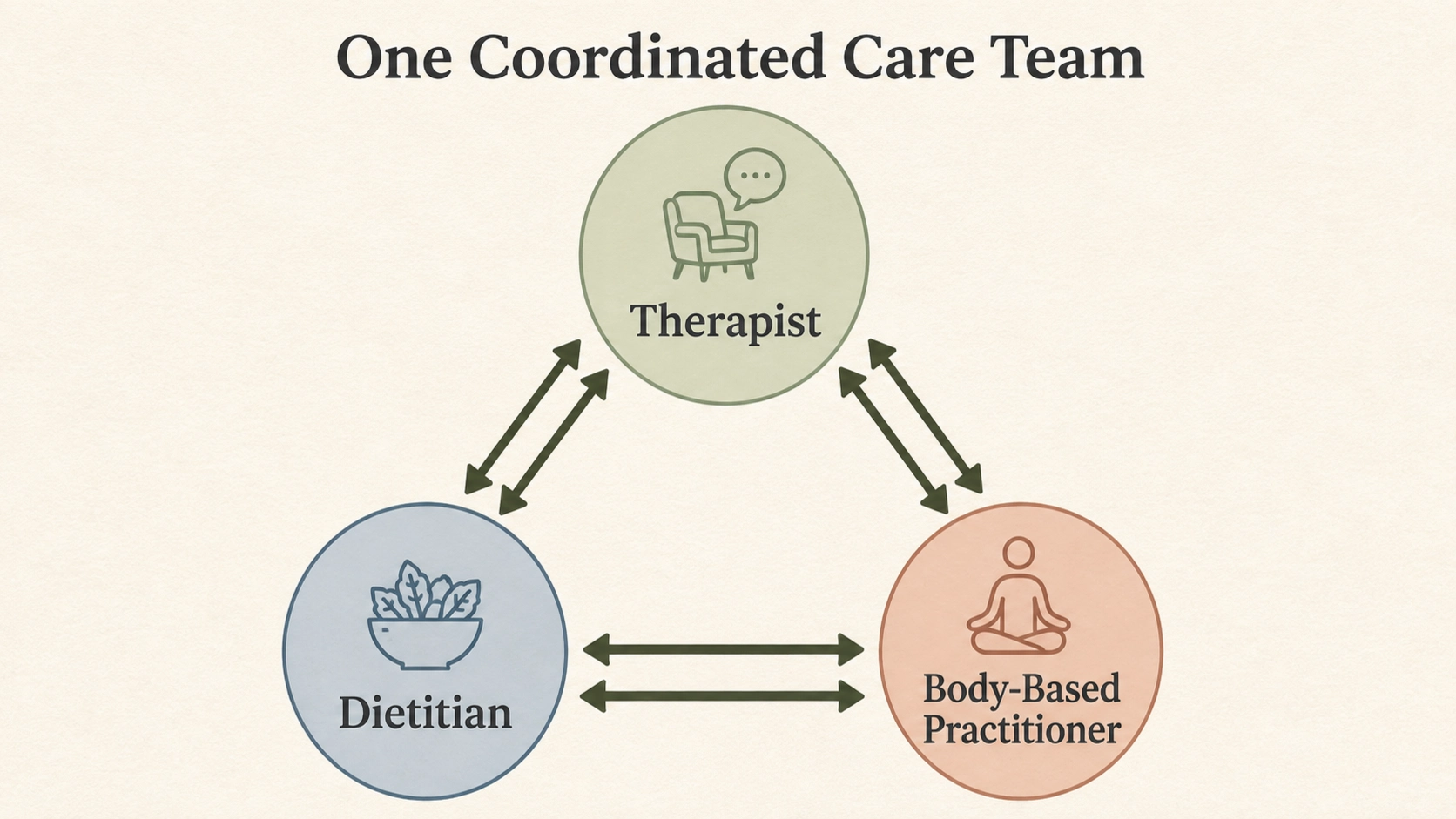
Outpatient eating disorder support usually involves more than one practitioner, because the difficulty operates on more than one level at once.
- A therapist. The central relationship. This is where the thinking, the history, and the function the behavior is serving get worked on. Eating disorders almost always sit on top of something else, frequently anxiety, trauma, or a period where control over food was the only control available.
- A dietitian. Not to hand you a plan, but to rebuild a working relationship with food, at a pace that is tolerable. Work with a non-diet dietitian looks nothing like the diet advice most people have encountered.
- Body-based work, where it fits. Eating disorders live in the body as much as in the thinking, and for many people talking is not sufficient to reach it. Gentle somatic work, breathwork and movement that is not about appearance can restore a sense of being in the body rather than at war with it.
- Medical oversight where needed. Coordinated with your physician, not replacing them.
The part that matters more than the list is that these people talk to each other. Assembling a therapist in one town, a dietitian in another, and a doctor who knows about neither is the arrangement most people end up with, and it puts the coordinating work on the person least able to carry it. It is the main practical argument for finding eating disorder support in Bergen County under one roof rather than three separate appointments.
Care under one roof is not a luxury here. It is the difference between a team and three calendar entries.
What the first appointment is like
You will not be weighed. You will not be asked to describe behaviors in detail on day one. You will not be handed a plan.
The first conversation is about what your life currently looks like and what you want to be different. How your days go. What you have already tried.
What you are worried will happen if you get help, which is usually a more revealing question than any of the others.
Many people arrive braced for judgment or for a plan they will be expected to follow immediately, and neither happens. The first session is establishing whether this is the right room.
If it is not, we will say so and help you find a better fit, including a higher level of care if that is what you actually need.
If you are calling about someone else
A large share of first calls come from a parent, a partner, or a friend rather than from the person themselves. That is a reasonable thing to do and it is worth knowing what is and is not possible.
- We can talk to you about how to approach it. How to raise it, what tends to land and what reliably backfires, and how to stay in the relationship while being honest.
- We cannot make someone come. Ambivalence is a feature of these conditions rather than a sign of not caring, and pressure usually increases resistance.
- Talk about the person, not the food. Conversations that focus on eating, appearance or specific behaviors tend to close down immediately. Conversations about how withdrawn someone has become, or how much they seem to be carrying, tend to stay open.
- Do not comment on anyone's body, in either direction. Remarks intended kindly are frequently the ones that do the most damage.
- Get your own support. Living alongside this is genuinely difficult and you are allowed to need help with it.
When to reach out
The honest answer is earlier than you think, and certainly before it reaches whatever severity threshold you have privately set for yourself.
These conditions respond considerably better to earlier intervention, and the instinct to wait until things are bad enough is itself part of the pattern.
If food or your body is taking up more room in your day than you want it to, that is sufficient reason for a conversation. You do not need a diagnosis, and you do not need to have decided you want to change anything yet.
If what you are dealing with involves urgent medical risk, or if you are having thoughts of not wanting to be here, that needs same-day attention rather than an appointment next week. The 988 Suicide and Crisis Lifeline is available by call or text at any hour.
Do I have to be diagnosed with an eating disorder to get support here?
No. Many of the people we work with would not meet full diagnostic criteria and are still spending a significant portion of their life on this. Being under a threshold is not the same as being fine. Most of what we do is eating disorder help for adults who have been managing something quietly for a long time.
Will I be told to gain or lose weight?
Weight is not the goal of the work. Where there is a genuine medical concern, that is addressed openly and in coordination with your physician, but it is not what progress is measured by.
I have been to treatment before and it did not work. Is it worth trying again?
Frequently yes. Eating disorder recovery is rarely linear, and the reason it did not work the first time is worth examining rather than treating as evidence about you. A weight-focused program, a poor fit with a clinician, or the wrong level of care at the wrong moment all produce the same outcome, and none of them mean the next attempt goes the same way.
How do I find an eating disorder therapist near me?
Ask two questions before you book: whether the approach is weight-neutral, and whether the practitioners coordinate with each other. Those two answers separate genuine eating disorder support in Bergen County from a general therapist who takes the occasional case. If you want to understand how body-based work fits alongside talk therapy, our post on what happens in a first sound healing session covers how the two run together here.
Ask us where to start
The free 15 minute discovery call exists for exactly the conversation that is hardest to start. It is not an intake, and you do not have to have decided anything before you make it.
You say what is going on. We listen, ask a few questions, and help you work out a reasonable next step, whether that is with us or somewhere better suited. If you need a higher level of care than outpatient support, we will tell you that plainly.
Call (201) 708-8448 or book your free discovery call. Melanie, our founder, answers every call.
This blog post is for informational purposes only and does not constitute professional mental health advice, diagnosis, or treatment.