
Introduction
Internal Family Systems is one of the modalities our team uses when understanding has stopped being enough. Julia Tsakalis, LCSW, our IFS-trained clinician, works this way with clients whose patterns have outlasted every insight they have had about them.
"Part of Me Wants To"
Listen to how people actually describe their own decisions.
Part of me wants to take the job. Part of me knows I should leave. A piece of me still hopes he calls. Some part of me is furious and I don't even know why.
We say this constantly and we do not mean it literally. It is a figure of speech for ambivalence.
Internal Family Systems starts by taking it literally. The whole model follows from that one decision.
The Premise
IFS was developed by Richard Schwartz in the 1980s. He was trained as a family therapist, working with families as systems where each member holds a role and the roles interlock, and he noticed his individual clients describing their inner lives in exactly those terms.
They did not describe a single self with mixed feelings. They described something closer to a household. Someone inside them was critical. Someone was terrified. Someone wanted to burn it all down. These voices had consistent personalities, appeared in predictable situations, and argued with each other in ways clients could narrate in detail.
Schwartz stopped treating this as metaphor and started treating it as structure. The mind, in this model, is naturally multiple. Not fragmented, not dissociative, not disordered. Multiple by design.
This is a real departure. Much of psychotherapy treats internal conflict as something to resolve so a unified self can emerge. IFS treats the multiplicity as healthy and the conflict as a coordination failure between members who are all, without exception, trying to help.
That last clause is the part people resist and the part that does the work.
Every Part Has a Job
The central claim of IFS is that there are no bad parts.
The inner critic narrating your failures at three in the morning is not there to hurt you. It formed at some point, usually early, because being harshly self-monitoring felt safer than being caught off guard by someone else's criticism. It has run that job ever since, without a performance review, using tactics that made sense at nine and make considerably less sense now.
The part that reaches for a drink at the end of a hard day is not weakness. It is doing crisis intervention with the only tool it trusts.
The part that goes cold the moment a relationship gets close is not sabotage. It is a security system installed after something happened, never told the threat has passed.
This reframe is practical, not just philosophical. The standard approach to unwanted internal experience is to fight it. Silence the critic. Suppress the anxiety. Override the avoidance.
IFS argues that fighting a part reliably strengthens it, because you are attacking something whose entire function is protection, and protective systems respond to attack by escalating. Anyone who has tried to willpower out of a habit and watched it intensify has already run this experiment.
The alternative is to find out what the part is protecting and address that. The part relaxes when its job becomes unnecessary. It does not relax because you told it to stop.
The three kinds of parts
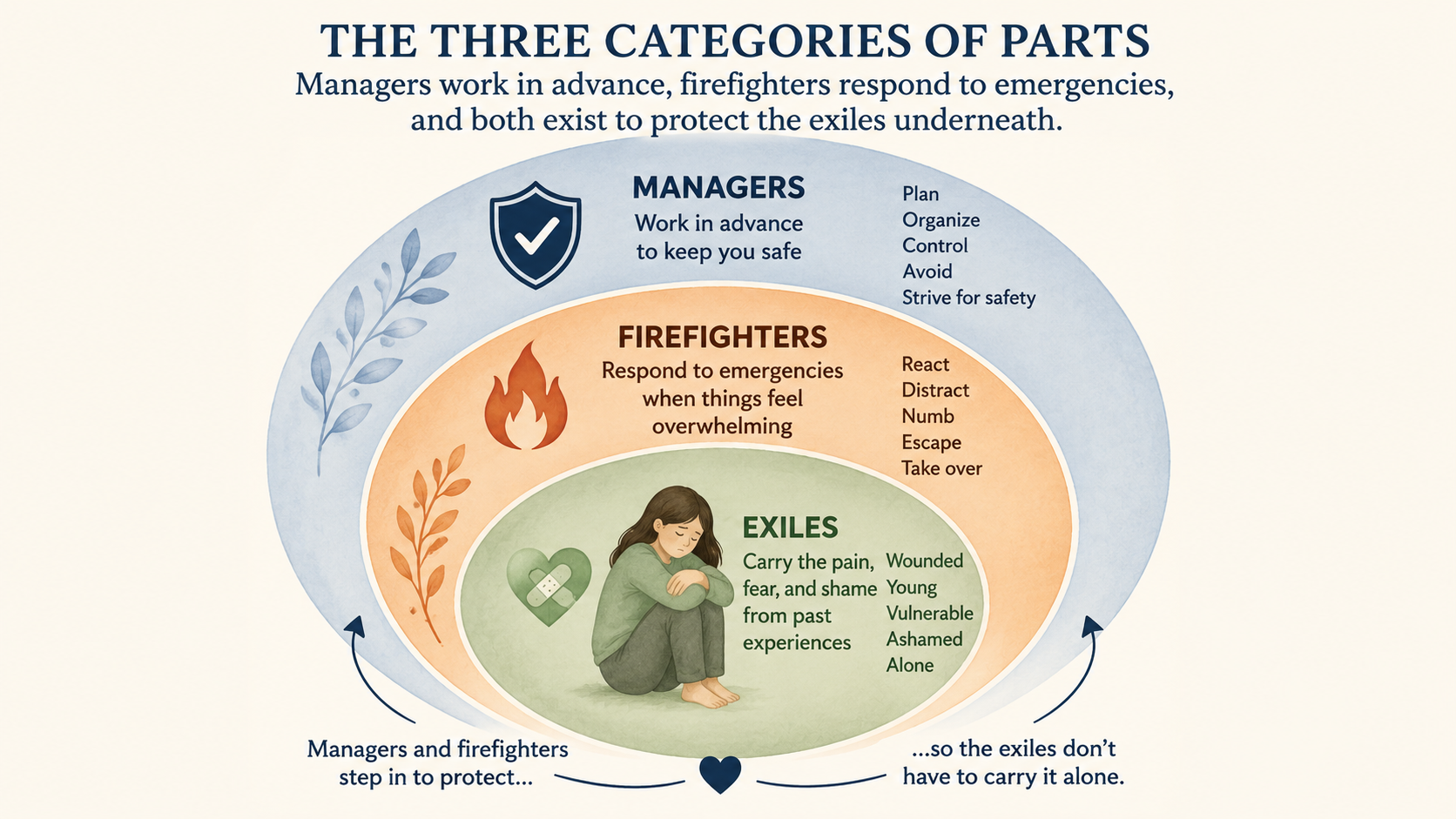
Managers run prevention. They work in advance to keep painful experiences from happening at all — the perfectionist, the planner, the people-pleaser, the inner critic, the part that rehearses conversations for hours. Managers are usually the most visible parts in daily life, and often the ones other people compliment you for. High-functioning is frequently a manager working overtime.
Firefighters run emergency response. When pain breaks through anyway, they act immediately and are notably indifferent to consequences — drinking, binge eating, compulsive scrolling, rage, sudden shutdown, impulsive spending. Firefighters get judged harshly, by others and by the person themselves, and the judgment misses the point. A firefighter breaking a window is not vandalism. Something is burning.
Exiles carry the original pain. Usually young. Usually holding shame, terror, grief, or the belief that something is fundamentally wrong with you. Managers work to keep exiles from surfacing; firefighters work to suppress them when they do. The entire protective apparatus exists around these parts.
Seen this way, a lot of behavior stops looking irrational. The person who is rigidly controlled all week and falls apart on Friday night is not inconsistent. Their managers hold the line, exhaust themselves, and hand off to firefighters at the first opportunity. The system is working as designed. The design is just old.
Self
The other component is what Schwartz calls Self, and it is where people either lean in or get suspicious.
The claim is that underneath the parts there is something that is not a part. It cannot be damaged, does not need building, and is present in everyone regardless of history. Schwartz describes it through qualities that appear when parts step back: calm, curiosity, clarity, compassion, confidence, courage, creativity, connectedness.
You have been in Self. It is the state where a friend tells you something hard and you are simply present with them, not managing your reaction or planning your response. It is the moment in a crisis when the panic drops away and you do the next necessary thing.
The therapeutic claim is that Self is what heals parts — not the therapist, and not technique. The therapist's job is to help you access enough Self that your parts can be met by you, which is what they have been waiting for.
You do not have to believe this to benefit. Plenty of people engage the model pragmatically, as a useful frame, and get substantial results without signing on to any claim about an undamageable core.
What a Session Actually Sounds Like
Less mystical than the vocabulary suggests.
A client says she cannot stop working. Twelve-hour days, weekends, physical symptoms she is ignoring.
Rather than examining her relationship with productivity, the therapist asks her to notice the part that keeps her working and find where she senses it in her body. She locates it as tightness across her chest and upper back.
Asked how she feels toward that part, she says she hates it. That answer is information. The hatred is another part — a critic — and it needs to step back before anything useful can happen. So the therapist works with the critic first, acknowledging it, asking what it is worried would happen if it stopped.
Once there is room, she can turn toward the working part with actual curiosity. What is it afraid of? It answers the way parts do, not quite in words but clearly enough: if she stops, everything falls apart and everyone sees she was never good enough.
There is the exile. A younger part carrying the belief that her worth is entirely conditional on output.
The working part has been guarding that belief for twenty-five years. It has never been thanked, and it has never been asked whether it wants the job.
That is the shape of the work. Slow, specific, and much more like negotiation than like insight.
How This Fits With Everything Else Here
IFS pairs naturally with the body-based work in this practice, because parts are not purely cognitive. They show up as physical sensation, and locating them somatically is a standard part of the process.
Brainspotting and IFS are frequently used together. Brainspotting reaches material below language through fixed eye position; IFS gives that material a structure for relating to whatever surfaces. Julia is trained in both, which is not a common combination and is a meaningful advantage for clients whose trauma is layered.
Somatic therapy covers adjacent ground from the other direction, starting with the body's held patterns rather than the parts holding them.
IFS is also widely used with grief, which is why it appears in the work at our affiliated practice, Grief Unbound. Grief activates the whole system at once, and having a framework for the part that wants to talk about it, the part that cannot, and the part that is angry at everyone for moving on is more useful than treating grief as one undifferentiated feeling.
Frequently Asked Questions
Is IFS evidence-based?
IFS has a growing but smaller evidence base than CBT or EMDR. It is listed on the National Registry of Evidence-based Programs and Practices, and studies show promising results for depression, anxiety, PTSD, and rheumatoid arthritis pain. It is fair to call it promising and increasingly validated rather than as established as the longest-studied modalities. Any practitioner who tells you otherwise is overselling.
Does having parts mean I have dissociative identity disorder?
No. IFS describes normal psychological structure that everyone has. DID is a distinct clinical condition involving dissociative barriers between identity states, amnesia between them, and a specific trauma history. IFS is used in treating DID, but noticing that part of you wants one thing and part wants another is not evidence of it. It is evidence of having a mind.
Can IFS help if I already understand my patterns?

That is often exactly who it helps. Insight lives in one part of the brain and the pattern lives in another, which is why people can explain their own behavior with precision and still repeat it. IFS works on the part running the pattern rather than on your understanding of it.
You Probably Recognized One
If any of this landed, it likely landed on something specific. A critic you could hear while reading. A part that goes quiet when things get close. The one that reaches for something at the end of a hard day.
That recognition is the entire entry point. You do not need to understand the model, and you do not need to have decided anything about Self. You need one part you can name.
Some honest limits before you call. IFS is not the right first move during acute crisis — stabilization comes first. It is not the primary intervention for active psychosis or unmanaged bipolar mania. And some people simply find the parts language unusable, which is a reason to work with a therapist who frames things differently rather than to force it.
If you are in crisis right now, please go to an emergency room or call 988. We are an outpatient practice and not equipped for acute risk.
Otherwise, the call is fifteen minutes and costs nothing. Melanie takes them herself. Describe the pattern you cannot shift and the part you noticed while reading this. She will tell you whether IFS is the right door, whether Brainspotting or somatic work should come first, or whether what you need is somewhere other than here — and if IFS is the fit, she will connect you with Julia directly.
Call (201) 708-8448 or book a free 15-minute call.
About the author

Melanie Struble, LCSW, LCADC is the founder and clinical director of the Center for Mind Body Balance in Saddle River, NJ. A licensed clinical social worker and licensed clinical alcohol and drug counselor with more than 33 years in practice, she specializes in addiction, eating disorders, anxiety, and grief. She founded the Center in 2016 to bring licensed therapy and body-based care under one roof, and she still takes every discovery call personally.