Introduction
As a licensed clinical social worker with more than 33 years of practice in Bergen County, I have spent a lot of time talking with prospective clients who have already been to two or three other wellness practices, paid for packages that didn't deliver, and ended up frustrated. The pattern is almost always the same: they chose based on marketing, not on fit. This guide is what I would tell a friend before they booked anywhere.
"Holistic wellness center" is a category that includes everything from licensed integrative clinics to single-modality studios to spa-style aesthetic businesses. The right one for you depends on what you are actually trying to address — and on what the practice can credibly deliver. This guide gives you a 6-question framework that licensed clinicians use to evaluate practices, plus the red flags worth walking away from.
What "Holistic Wellness Center" Actually Means (and Doesn't)
The phrase has no regulatory definition. Anyone can call their business a holistic wellness center, including businesses that have no licensed clinicians on staff, no clinical oversight of body-based modalities, and no protocols for safety or referral. Unlike a term such as Licensed Clinical Social Worker or Licensed Acupuncturist — which require specific training, examination, and ongoing oversight — "wellness center" requires nothing more than a business license and a willingness to use the words.
That does not mean those businesses are bad — they may be excellent at what they do. It means the phrase itself tells you very little. What matters is what is actually being offered, by whom, and how the practice handles the complexity of the human you are bringing in the door.
The three rough categories
In Bergen County, "holistic wellness center" practices generally fall into one of three categories:
- Licensed clinical practices with integrative offerings. Mental health licensure (LCSW, LMFT, PhD, MD/DO) is the core; body-based modalities are added under clinical oversight. These are best for trauma, anxiety, depression, addiction recovery, and any condition where clinical care is part of the picture.
- Single-modality studios that brand as wellness centers. Yoga studios, massage practices, acupuncture clinics. Often excellent at the modality they specialize in; less equipped for clinical complexity or for integrating across modalities.
- Spa-style aesthetic-wellness businesses. Facials, body treatments, occasional wellness adjuncts. Best for stress relief and self-care; not designed for clinical work.
Knowing which category a practice sits in is the foundation of every other decision. Now to the questions.
The 6 Questions to Ask Before Booking
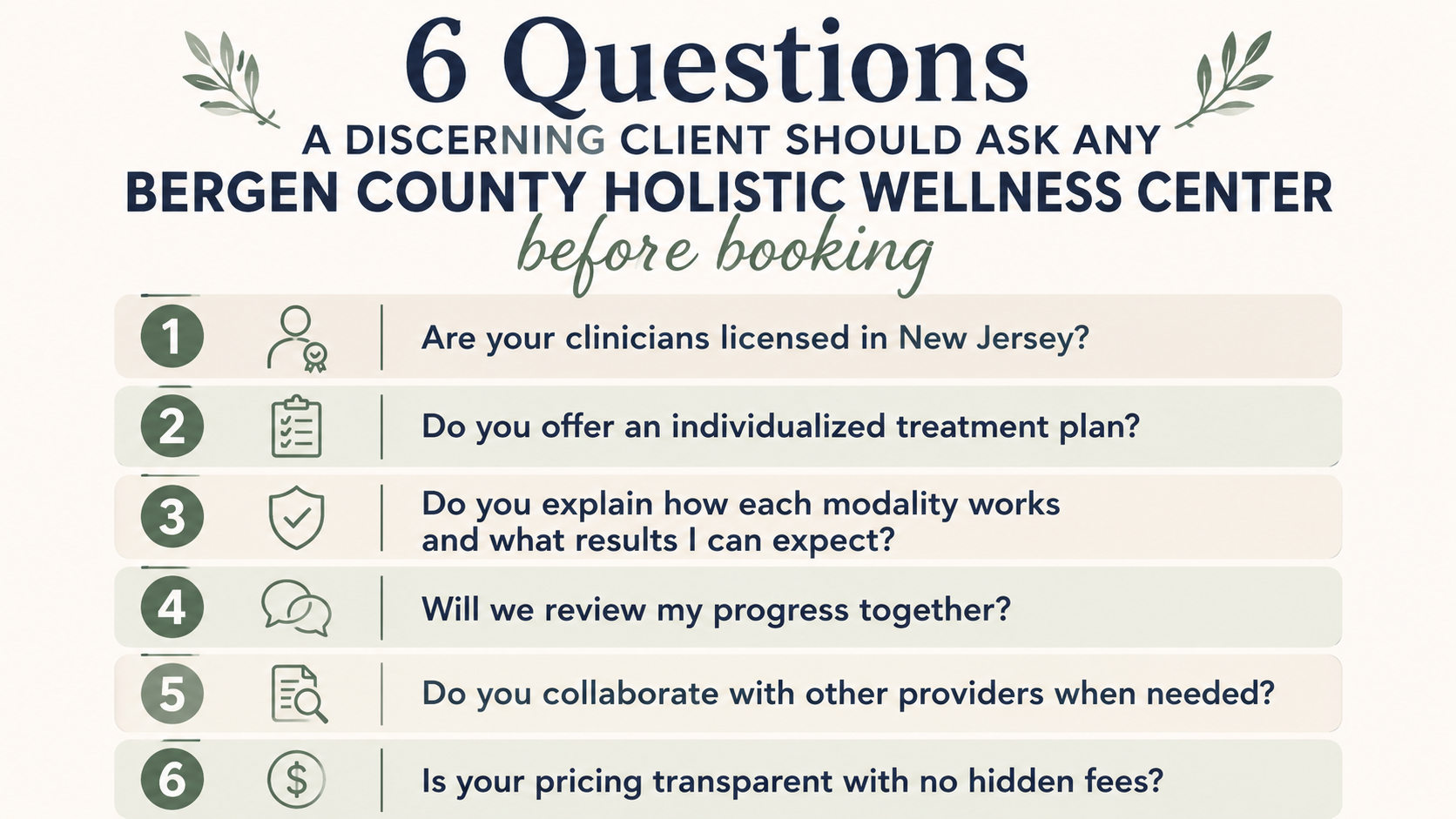
You do not need to ask all of these in one call. But before you commit to a long-term relationship with a practice, the answers to these questions should be clear.
1. Who is licensed, and in what?
A good integrative practice will tell you, plainly, which of their practitioners hold what licenses. Mental health work should be done by clinicians licensed in your state (LCSW, LMFT, LCADC, psychologist, psychiatrist). Acupuncture should be done by a licensed acupuncturist. Body-based modalities like reiki, sound healing, and breathwork have varying credentialing standards — what matters is that the practice can articulate them and can speak to the quality of training their practitioners have.
A vague answer here is the first red flag.
2. What modalities do they actually offer — and which do they outsource?
Some practices list ten services on their website, all delivered by one practitioner with weekend-certification training in each. Others list six and have a fully credentialed practitioner for each one. Ask which practitioners on the team do what. Ask which of the listed offerings are actually delivered in-house weekly versus occasionally or by visiting practitioners.
3. How do practitioners coordinate across modalities?
This is the most important question and the one most likely to separate genuine integrative practices from collections of services under one roof. At a true integrative practice, your therapist talks to your acupuncturist. Your somatic practitioner flags what they are noticing to your clinician. Referrals between modalities happen on the day they are identified, not weeks later.
Ask: "If I'm working with one of your therapists and they think I'd benefit from somatic work, what happens?" The answer should describe a clear, fast, human process — not a referral form and a wait list.
4. What does the intake process look like?
The intake tells you a lot about the practice. A 45-minute clinical intake with a licensed clinician suggests a serious assessment. A short paper form and an immediate booking suggests a transactional model. Neither is automatically wrong — but make sure the depth of the intake matches the depth of the work you are trying to do. At our Saddle River practice, every prospective client gets a free 15-minute discovery call with the founder — not an automated form, not a front-desk screening. That sets the tone for the kind of clinical attention you'll get if you become a client.
5. Will they refer you out if you're not the right fit?
This is the most underrated diagnostic question, and a willingness to refer out is the single strongest signal of clinical maturity. A practice that says "we can help with everything" is either inexperienced or selling. A practice that says "based on what you're describing, we think a psychiatrist or a different specialist is the better starting point" is taking your well-being seriously over their revenue.
Ask directly: "If I am not the right fit for your practice, would you refer me elsewhere?" The answer should be enthusiastic and specific.
6. What does the physical space feel like?
This sounds soft. It is not. The space you walk into sets your nervous system before a single hand touches you, and a body that is bracing does not release.
Notice what happens in the first thirty seconds. Does the noise of the day drop away when the door closes behind you? Is the light warm instead of clinical? Can you hear the person in the next room, or only quiet? A good space asks nothing of you. You should be able to exhale in the waiting area without deciding to.
Then look at the structure underneath the feeling. Treatment rooms should be fully separate from the reception area, not divided by a curtain or a hallway. There should be enough rooms that your session is never rushed to free one up. Privacy should be built in, not improvised.
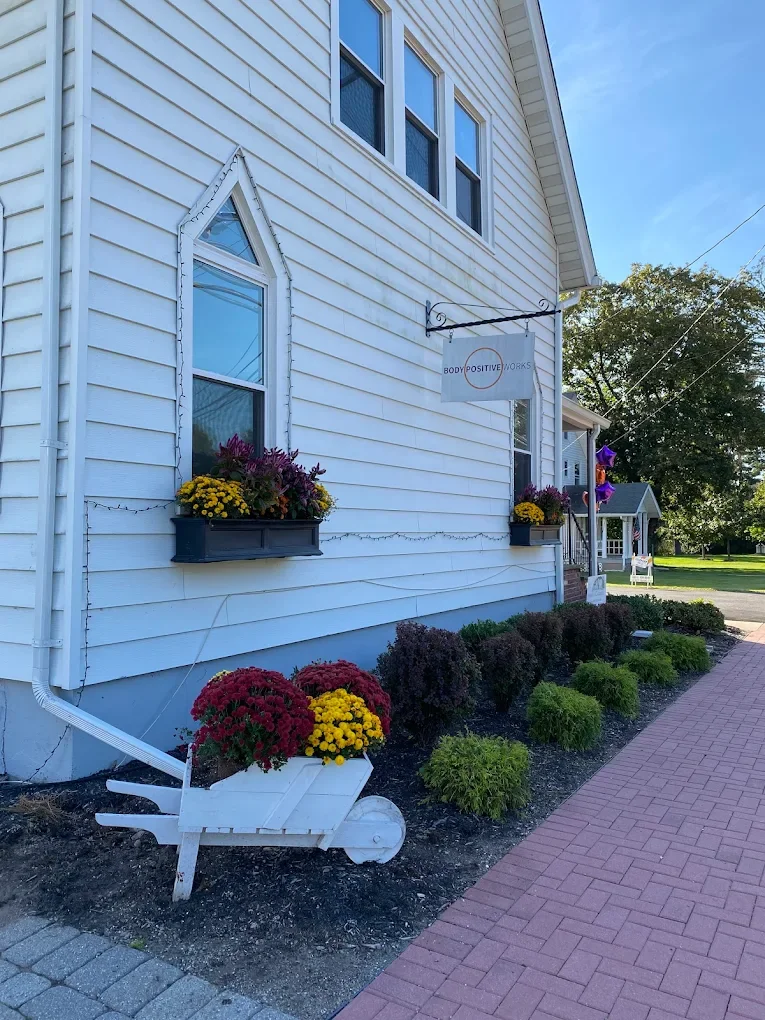
Our practice lives in a 200-year-old building with thick walls, real doors, and rooms that were made to hold quiet long before anyone called it wellness. Not every practice has that history, but every practice has an answer. Ask for it. Visit in person, or request a video walkthrough, and pay attention to how your shoulders sit when you leave.
Red Flags Worth Walking Away From
If you encounter any of the following, it is worth pausing.
- Vague credentials. "Our team has years of experience" is not an answer. Specific licenses, specific training, specific credentials are.
- Sales-style intake. If the first conversation is more about packages and pricing than about your situation, you are in a sales funnel, not a clinical relationship.
- Promises that exceed plausible scope. No reputable practice will tell you they can "cure" trauma, depression, or chronic illness in a fixed number of sessions. Anyone who does is either inexperienced or unethical.
- No willingness to refer out. A practice that handles everything in-house, including conditions clearly outside their scope, is putting their revenue ahead of your care.
- No clinical oversight of body-based modalities. If reiki, sound healing, or somatic work is being offered alongside trauma work without any clinician involvement, that's a structural problem — body-based work with traumatized people requires someone who understands the clinical risks.
- Pressure tactics. "Limited time," "act now," "session packages with steep cancellation fees" all belong to retail, not healthcare.
- Difficult-to-reach humans. If you can't get a human on the phone for a basic question before booking, what happens when something is hard?
How We Try to Earn the Answers
At the Center for Mind Body Balance, our answers to the six questions look like this:
-
Licensing. Licensed clinicians — Melanie Struble LCSW LCADC, Wendy Coffey LCSW, Julia Tsakalis LCSW — plus credentialed somatic, sound, and movement practitioners.
-
Modalities. Psychotherapy, somatic yoga, breathwork, sound healing, reiki, Stott Pilates, acupuncture, IFS, and Brainspotting — all delivered in-house by named practitioners.
-
Coordination. Practitioners share one 200-year-old building; referrals happen down the hall on the day they're identified.
-
Intake. A free 15-minute discovery call with Melanie before any commitment.
-
Referrals. Yes — Melanie refers out regularly when we're not the right fit.
-
Space. The 1820 building at 96 East Allendale Road, originally the Zion Evangelical Lutheran Church, the oldest surviving church in Bergen County.
We share this not because we are the only practice that can answer these questions credibly — there are several excellent integrative practices in Bergen County. We share it because the answers are the kind of detail you should be hearing from any practice you are considering, and the easiest way to ask for them is to model what they look like.
Frequently Asked Questions
What's the difference between a holistic wellness center and an integrative health practice?
The terms are often used interchangeably, but "integrative health practice" usually implies licensed clinical care (medical, mental health, or both) combined with complementary modalities, while "holistic wellness center" can describe almost anything. When clinical work is part of what you need, look for "integrative."
How do I know if a holistic wellness center is right for trauma?
The presence of licensed mental health clinicians (LCSW, LMFT, PhD, psychiatrist) trained specifically in trauma modalities — EMDR, Brainspotting, IFS, somatic experiencing — is the minimum bar. A practice without licensed trauma-trained clinicians may still be excellent for stress relief and general wellness, but is not the right place to do trauma work. Our somatic vs. talk therapy guide has more on what to look for.
How much should a holistic wellness center cost?
There is no standard rate, and any figure quoted online will be wrong for someone. What matters more than the number is whether a practice will give it to you before you book. Ask what a single session costs by modality, whether they take insurance or provide superbills for out-of-network reimbursement, and whether any package or minimum commitment is involved. Be cautious with prepaid blocks of sessions — clinical work should be able to end when it's done, and a practice that needs twelve sessions bought upfront has made a revenue decision about your care before anyone has assessed you.
Now Use This On Us
If this framework is any good, it should survive being pointed at the practice that wrote it.
So bring the six questions to your call with us. Ask who is licensed and in what. Ask which modalities are delivered in-house and by whom. Ask what happens on the day a therapist thinks you need somatic work. Ask whether we would refer you elsewhere.
Ask us the same things you would ask anyone, and hold the answers to the same standard. If we cannot answer them cleanly, that tells you something worth knowing — and you will have lost fifteen minutes rather than the cost of a package.
We would also rather you took this list to three other practices in Bergen County and picked the one that fits than booked with us because we ranked well in a search. There are several good integrative practices here. Being the right one for a particular person is a narrower thing than being good.
Melanie answers the phone herself. Fifteen minutes, no charge, no commitment.
Call (201) 708-8448 or book a free 15-minute call.
About the author
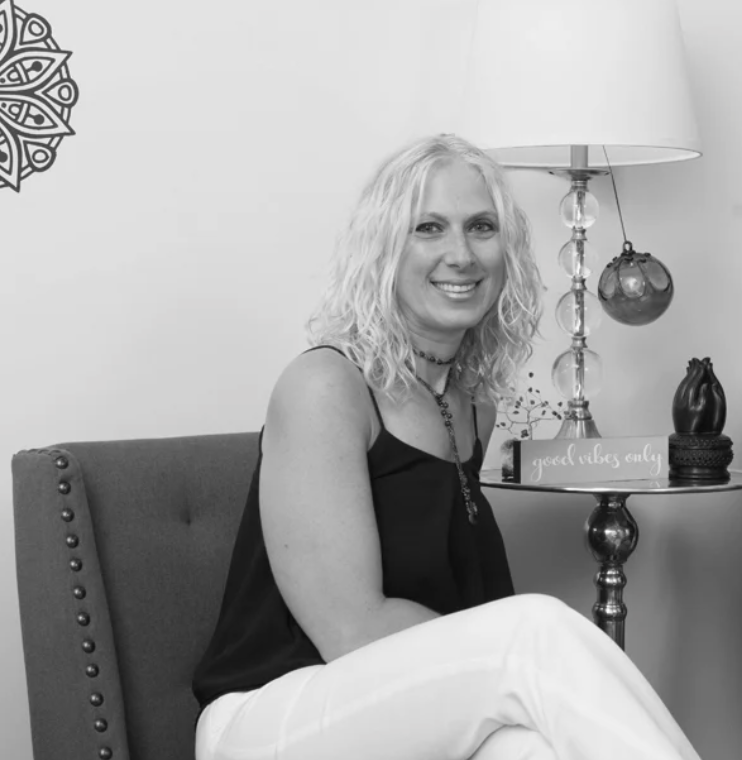
Melanie Struble, LCSW, LCADC is the founder and clinical director of the Center for Mind Body Balance in Saddle River, NJ. A licensed clinical social worker and licensed clinical alcohol and drug counselor with more than 33 years in practice, she specializes in addiction, eating disorders, anxiety, and grief. She founded the Center in 2016 to bring licensed therapy and body-based care under one roof, and she still takes every discovery call personally.