Back to School Anxiety
The first week of September in a Bergen County household is a specific kind of chaos. Wake times move by an hour or more, four different schedules have to be reconciled, and somebody is standing in the hallway saying their stomach hurts.
Most of the advice written about this is aimed at the child. That is half the situation. The adult managing the transition is going through the same nervous system shift, usually with less sleep and no one asking how they are doing.
What September actually asks of a nervous system
Bodies run on prediction. A nervous system that knows what is coming spends very little energy on vigilance, which is why the back half of August is generally calm even in households that are not especially organized.
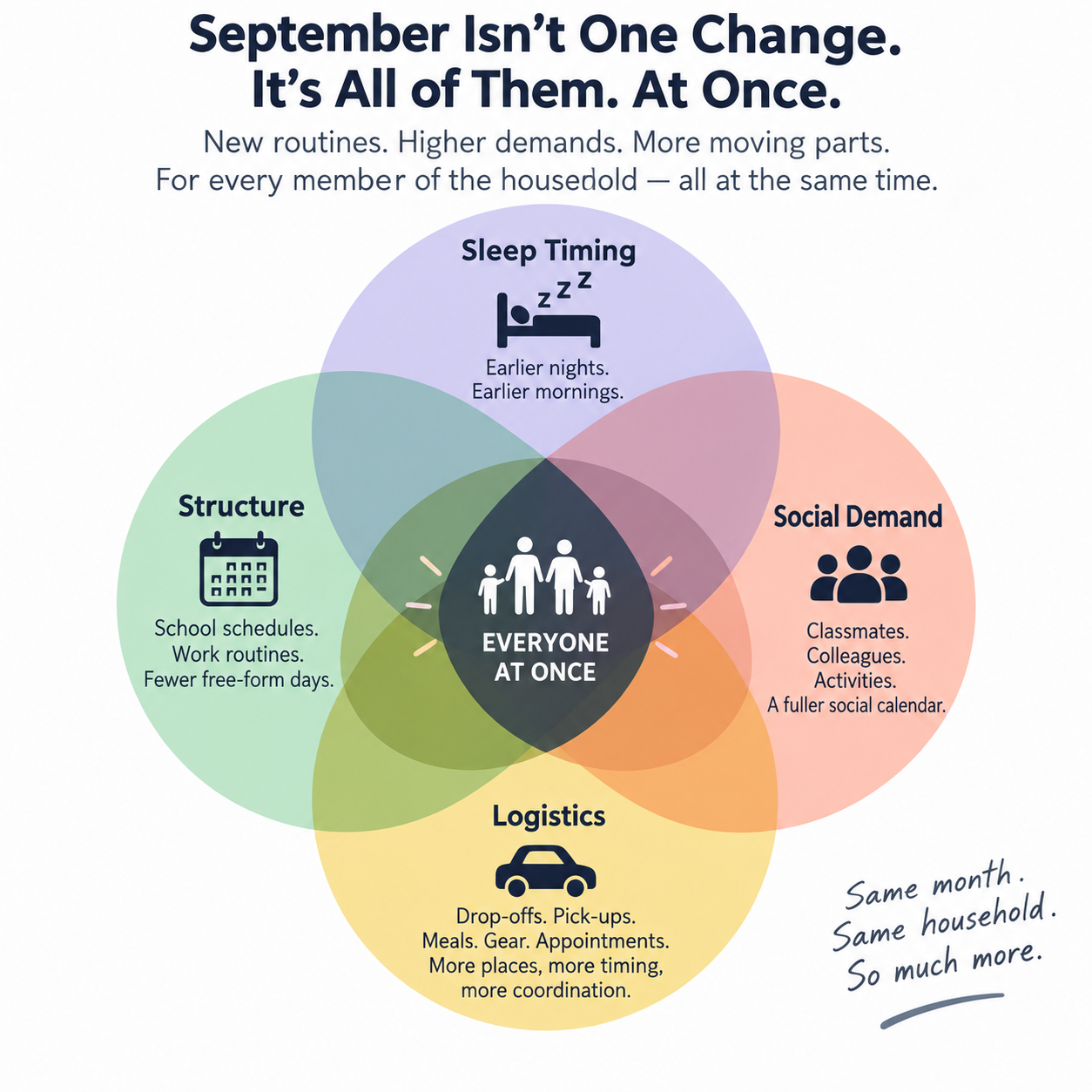
September removes the predictability from four things at once. Sleep timing shifts. Structure returns after weeks without it. Social demand goes from a handful of familiar people to a building full of them. Logistics multiply. Each of those alone would take a week or two to absorb. Arriving together, they produce a period where everyone in the house is running slightly hot.
This is worth naming for children explicitly, because the alternative explanation they usually reach is that something is wrong with them. Telling a nine-year-old that their body is doing extra work this week because everything changed at once is accurate, and it is considerably more useful than telling them there is nothing to worry about.
What it looks like in children
Rarely as a child saying they feel anxious. Almost always as something else.
- Stomach aches and headaches, particularly in the morning. These are real sensations. Anxiety produces genuine gut and muscular symptoms, and treating a child as though they are inventing it damages trust without reducing the anxiety.
- Irritability and short fuses at home. Children frequently hold themselves together all day at school and release it in the one place that feels safe. Being the target of that is a sign you are the safe place, though it does not feel like a compliment at 6pm.
- Sleep trouble at both ends. Difficulty getting to sleep, early waking, or both.
- Regression in younger children. Clinginess, bedwetting, or wanting things they had outgrown. Almost always temporary.
- Withdrawal in teenagers. Less talking, more door closing. Distinguishing ordinary adolescent privacy from a change worth attending to is mostly a question of whether it is a shift from their baseline.
- Resistance at the door. Which is where most families find the difficulty becomes undeniable.
What helps with the child
- Rebuild sleep before term, not during it. Move bedtime and waking earlier by fifteen to twenty minutes a day across the preceding week. This is unglamorous and it does more than everything else combined.
- Do the logistics in advance and in daylight. Walk the route, find the classroom, meet the teacher if that is possible. Uncertainty is the fuel here, and every unknown removed in advance is one the nervous system does not have to run at 7am.
- Name the feeling without arguing with it. "You are nervous about tomorrow, and that makes sense" works. "There is nothing to be nervous about" invites a child to prove there is.
- Give the body something to do. Slow breathing with a longer out-breath than in-breath produces a measurable shift in autonomic state and children take to it more readily than adults do. Our post on breathwork for anxiety sets out the mechanism and a short practice that adapts easily.
- Consider what the body is already carrying. Where a child is anxious and also not sleeping, the sleep is usually the thing to address first, because a tired nervous system has no margin for anything else. Our post on what is actually keeping you awake applies to adults and the mechanism is the same in children.
- Keep the morning conversation minimal. Anxious mornings are not the time for a discussion about feelings. Get out of the door, talk at 4pm.
- Expect two to three weeks. Most transition anxiety resolves in that window. Knowing the timeline stops a normal fortnight being read as a crisis.
The half nobody plans for
Parents get the same nervous system shift with additional load: the logistics, the mental scheduling, the return of a working rhythm that August had softened, and frequently a quiet dread about the year ahead.
This matters practically rather than sentimentally. Co-regulation is real and it runs downhill. A child borrows the state of the adult in the room, which means a settled parent is the single most effective anxiety intervention available in the house, and an adult running on four hours sleep and caffeine is working against everything else they are trying to do.
There is also a version of this that arrives specifically in midlife, where September lands on top of a hormonal transition already affecting sleep and tolerance. If the last two Septembers have been markedly worse than the ones before, that is worth reading about in our post on perimenopause and the nervous system before concluding it is the school run.
So the useful framing is not self-care as a reward for getting through the week. It is that your own regulation is part of the intervention. Ten minutes of something that settles you before the school run is not indulgence, it is the most efficient use of ten minutes available to you.
Practically: protect your own sleep with the same seriousness you are applying to theirs, do not schedule anything optional into the first fortnight, and if September is the month your own anxiety reliably arrives, book something before it does rather than after.
When it is more than a transition
Most of this settles by early October. Some signals suggest it is worth a conversation rather than more time.
- Refusal to attend that persists past two or three weeks, or escalates.
- Physical symptoms severe enough to interfere with eating or sleeping.
- Panic symptoms rather than reluctance: racing heart, difficulty breathing, a sense of something terrible about to happen.
- Withdrawal from friends and activities they previously enjoyed.
- Any expression of not wanting to be here. This warrants immediate attention, and the 988 Suicide and Crisis Lifeline is available at any hour by call or text.
- A transition that is difficult because of something else, most often a death, a separation, or a family illness. Grief shows up in September with particular force, because the new year makes the absence structural rather than occasional. Our sister practice Grief Unbound has written specifically about grief in children and teenagers.
The American Academy of Pediatrics publishes plain guidance for parents on childhood anxiety, and is a reasonable first read before deciding whether to seek an appointment.
Frequently Asked Questions
Is my child faking the stomach aches?
Almost certainly not. Anxiety produces real gastrointestinal symptoms through a well-documented pathway, and children are frequently more accurate about the physical sensation than about its cause. Treating the sensation as real while still going to school is usually the right combination.
Should I let them stay home on a bad morning?
As a general rule no, because avoidance reliably strengthens anxiety. The exception is where something specific is happening that needs addressing rather than pushing through. If mornings are consistently a battle, that pattern is worth professional input rather than being fought daily.
How do I know if my own anxiety is affecting them?
Assume it is, in both directions, and treat that as useful rather than as guilt. Children are extremely accurate readers of adult state. The practical implication is that working on your own regulation is a legitimate part of helping them, not a distraction from it.
Ask Us Where to Start
If September arrives every year with the same difficulty, the useful time to do something about it is now rather than in November.
The free 15 minute discovery call is a conversation, not an intake. You describe what the household actually looks like, and we help you work out whether the useful support is for your child, for you, or for both. If we are not the right fit, we will say so and point you somewhere that is.
Call (201) 708-8448 or book your free discovery call. Melanie, our founder, answers every call.
This blog post is for informational purposes only and does not constitute professional mental health advice, diagnosis, or treatment.