
A woman in her mid-forties, no history of anxiety, arrives describing a year in which she has become someone she does not recognize. Rage at things that never bothered her. Awake at three every night. A sense of dread in the mornings with nothing attached to it. She has usually been told, somewhere along the way, that it is stress.
It is frequently not stress. This is one of the most commonly missed explanations in adult mental health, and missing it means people spend years working on the wrong problem.
What is actually happening
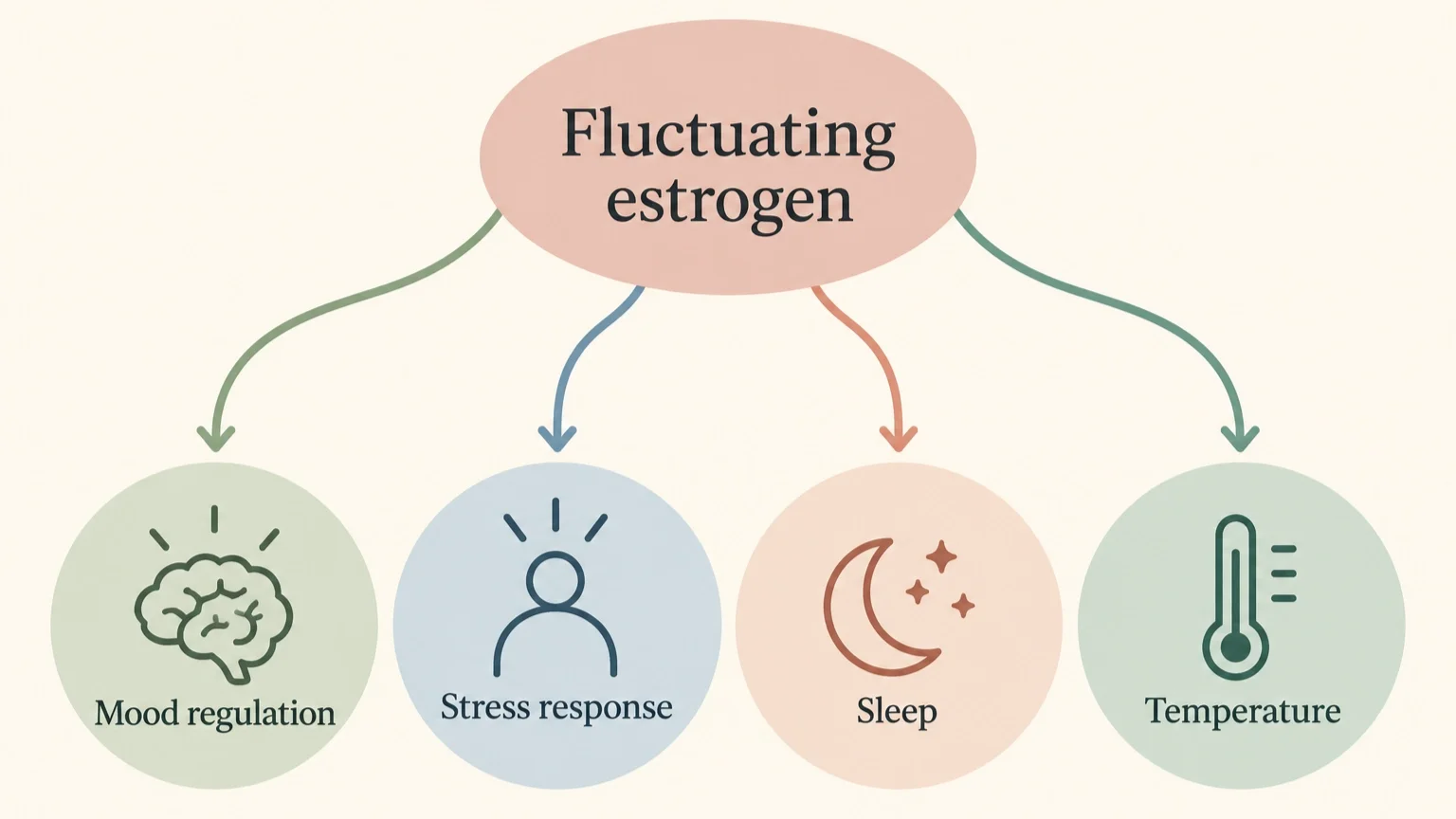
Estrogen is not solely a reproductive hormone. It has substantial and well-documented activity in the brain, including in the regulation of serotonin, in the functioning of the stress response system, and in sleep architecture. Receptors for it are distributed through regions involved in mood and threat detection.
Perimenopause, the transition preceding menopause, typically begins somewhere in the forties and can run for several years. The defining feature is not decline but instability. Levels fluctuate unpredictably, sometimes substantially within a single cycle. A system tuned to a relatively steady input is receiving an erratic one.
That instability is why perimenopause is frequently harder than menopause itself. A body can adapt to a new steady state. Adapting to an unpredictable one is considerably more demanding, and the adaptation is what is being felt.
The practical consequence is that the symptoms are genuinely physiological, and the common experience of being told to manage stress better is both unhelpful and slightly insulting. The National Institute on Aging publishes plain, non-commercial information on the transition, which is a useful counterweight to a subject that attracts a great deal of marketing.
The symptoms nobody connects to it
Hot flushes and cycle changes are the recognized ones. These are the ones people rarely attribute correctly.
- Anxiety appearing for the first time in midlife. Frequently physical rather than cognitive: a racing heart or chest tightness with no accompanying worried thought, which is confusing precisely because there is nothing to point at.
- Rage, disproportionate, and fast. Widely reported, rarely discussed, and often the symptom people are most ashamed of. It tends to arrive with no build-up and recede quickly, leaving a great deal of guilt behind it.
- Waking at three and staying awake. A characteristic pattern, driven by the interaction between hormonal change and cortisol regulation rather than by anything on your mind.
- Cognitive fog. Word-finding difficulty, losing the thread, walking into rooms. Genuinely frightening for many women, who reasonably wonder whether it is something worse. It is generally transitional.
- A flattening of interest. Not sadness exactly. Things that used to register simply not registering.
- Reduced tolerance for noise, demand, and people. Frequently the first thing families notice.
Read individually, each of these looks like a separate problem. Read together, in a woman in her forties, they usually have one upstream cause.
Where the line is
Anything hormonal belongs with a physician. Testing, medical management, and the decisions that follow from them are outside the scope of a wellness practice, and any practice suggesting otherwise is overreaching. If what you are reading here is recognizable, the first appointment to make is a medical one.
What therapeutic and body-based work adds is different and complementary: capacity while the transition runs, and it can run for years. A nervous system under sustained hormonal load has less margin than it used to. The work is on rebuilding some. In practice that means several things that are already covered elsewhere on this site, applied to this particular situation.
- Nervous system regulation you can do daily. Breathwork in particular, because it directly influences autonomic state and works on the physical anxiety that has no thought attached to it.
- Movement that is not about appearance. Somatic yoga suits this stage well, because it works with what the body is doing rather than asking it to perform.
- Acupuncture, which has a reasonable evidence base for vasomotor symptoms and for sleep, and which we cover in our post on acupuncture for anxiety .
- Blood sugar stability, which matters more at this stage than earlier, because a crash on top of hormonal instability produces a considerably larger reaction.
- Therapy for the identity part, which is real and is not a hormonal symptom. Midlife frequently arrives alongside adolescent children, aging parents, and a reckoning with the life that was planned.
The part that is not hormonal
It would be inaccurate to attribute everything to endocrinology. This stage of life reliably coincides with genuine losses: parents becoming ill or dying, children leaving, marriages being reassessed, careers reaching whatever they were going to reach.
Those are real and they deserve to be treated as such rather than folded into a hormonal explanation. Grief in particular is frequently mistaken for a perimenopausal symptom, especially where a parent has died in the same period, and it responds to entirely different work. Our sister practice, Grief Unbound, operates in the same building.
The useful position is that both are usually true at once, and separating them is part of what a first conversation is for. In practice the sorting is not difficult. Symptoms that track a cycle, arrive without a trigger, and center on sleep and temperature usually point one way. Symptoms that arrived alongside an event, and that are about meaning rather than physiology, usually point the other. Most women in their forties have some of each, and treating only one of them is why so many people conclude that nothing works.
What to raise with your physician
A recurring frustration in this area is that women describe these symptoms and are offered an antidepressant without the hormonal transition being discussed at all. That is not always the wrong treatment, and it should be a decision made with the full picture rather than by default.
Some things worth saying explicitly at the appointment because they are frequently not asked about:
- That the symptoms are new, and roughly when they started relative to your age and cycle.
- Whether they fluctuate with your cycle, which is one of the more informative signals available.
- The sleep pattern specifically, including what time you wake, since that is diagnostically useful.
- That you would like the hormonal transition considered as part of the picture. Asking directly changes the conversation more often than it should have to.
The North American Menopause Society maintains a directory of clinicians with specific training in this area, which is worth using, because general practice varies considerably in how much attention this transition receives.
Frequently Asked Questions
How do I know if it is perimenopause or anxiety?
Frequently both, and the distinction matters less than it appears. The practical questions are whether this is new, whether it tracks with your cycle, and whether it arrived without a life event to explain it. A physician can assess the hormonal side. It is worth raising specifically because it is not always asked about.
Will this pass on its own?
The transition ends, and many women find things settle considerably afterwards. The difficulty is that it can run for several years, which is a long time to wait without support.
Do you provide hormone treatment?
No. That is a medical decision and belongs with your physician. We work on the nervous system, the sleep, and the psychological dimension alongside whatever medical route you take.
Ask Us Where to Start
If you have spent a year assuming you are becoming a worse version of yourself, the most useful thing this article can do is offer a different explanation.
The free 15 minute call is a conversation, not an intake. You describe what has changed. We help you work out what would actually help, and we will tell you plainly if the first appointment you need is a medical one rather than one with us.
Call (201) 708-8448 or book your free discovery call. Melanie, our founder, answers every call.
This blog post is for informational purposes only and does not constitute professional mental health advice, diagnosis, or treatment.