
As a licensed clinical alcohol and drug counselor with 33 years in practice, the question I am asked most is some version of why they cannot just stop. It is usually asked by a family member, and there is a great deal of exhaustion behind it.
The answer is that stopping is not the difficult part. Most people with a substance problem have stopped many times. The difficult part is that whatever the substance was handling is still there the following morning, and nothing has replaced it.
The question that changes the picture
The conventional framing asks what is wrong with a person who uses. A more useful framing, associated with the work of physician Gabor Maté among others, asks what the substance is doing for them.
That is not a semantic distinction. It changes the entire treatment target. If someone is drinking because evenings are unbearable without it, then removing the alcohol leaves an unbearable evening. If someone is using because a nervous system shaped by early trauma has never had a reliable way to reach calm, then sobriety alone leaves them permanently uncomfortable in their own body, which is not a state anyone sustains indefinitely on willpower.
The short version is that the behavior is usually an intelligent solution to a real problem, with a cost that eventually exceeds the benefit. Recognizing the intelligence in it is not indulgence. It is the only way to work out what needs to be built before the solution can be given up.
What is usually underneath
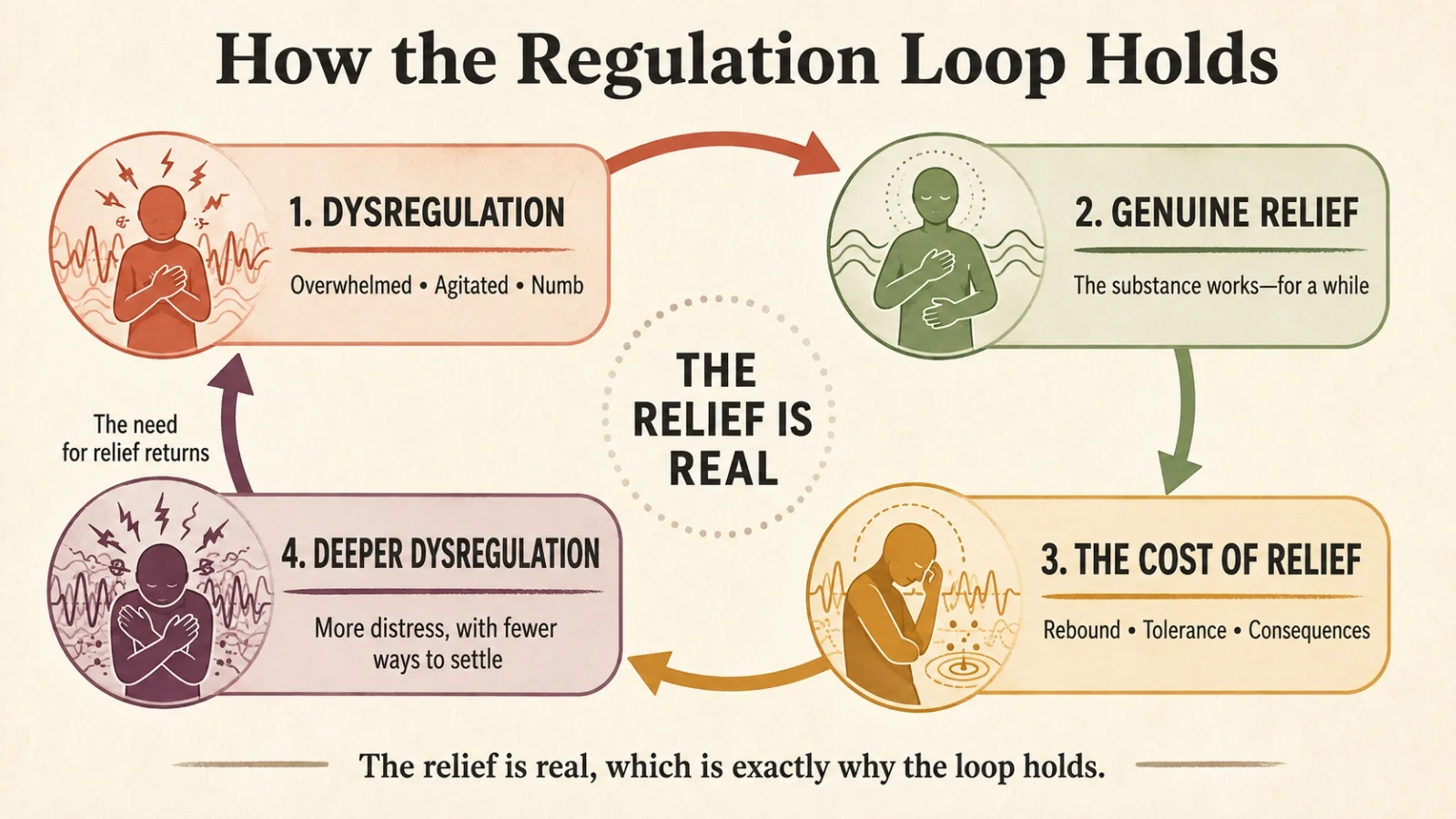
Four things come up repeatedly, often more than one at a time.
- Anxiety. By some distance the most common. Substances that reliably produce a few hours of quiet are extremely effective at treating anxiety in the short term, which is precisely the difficulty. The relief is genuine and the cost arrives later.
- Trauma. A nervous system carrying unprocessed trauma is running a threat response that has no off switch. Substances are one of the few things that will reliably interrupt that, and for many people they were the first thing that ever did. Our post on Brainspotting covers how trauma is reached directly rather than through talk alone.
- Grief. Substance use frequently escalates in the year after a significant loss, and it is very often missed, because everyone including the person attributes it to circumstances. Grief is exhausting and anything that produces a few hours off is difficult to decline.
- Chronic dysregulation without a clear cause. Some people have simply never had a reliable route to a settled state. There may be no identifiable trauma, and the difficulty is real regardless.
This is why treating the use in isolation so frequently produces a period of sobriety followed by a return. The problem the substance was solving did not go anywhere.
What this changes about treatment
If the substance was performing a regulation function, then recovery has to include building other ways to reach the same state. Not as a wellness add-on, but as the central work, because the alternative is asking someone to tolerate permanent discomfort on determination alone.
In practice that means the therapeutic work and the body-based work run together rather than sequentially. Sessions address the history, the patterns, and the function the use was serving. Alongside that, breathwork, somatic work, and other body-based approaches give the nervous system a route to settle that does not require a substance. People frequently describe the first time a breathing practice actually works on them as the moment recovery stopped feeling like deprivation.
It also means being clear about scope. Outpatient counseling and integrative support are appropriate for many people and are not appropriate for everyone. Where someone needs medically supervised detox, an intensive outpatient program, or inpatient care, the right response is a referral rather than an attempt to hold it. A practice that cannot say that plainly is not one to trust with this.
On relapse
Relapse is treated in a great deal of writing on this subject as a moral event. It is more accurately read as information.
A return to use tends to indicate one of a small number of things: something underneath was not addressed, a period of stress exceeded the capacity that had been built, a support structure fell away, or the alternative regulation strategies were not yet reliable enough to hold under pressure. Each of those is workable. None of them is a verdict on the person.
The practical consequence is that the useful response to a relapse is a specific conversation about what happened in the days beforehand, not a conversation about commitment. Shame is one of the more reliable predictors of a relapse becoming an extended return to use, largely because it stops people making the call they need to make.
What early recovery actually asks of a person
One thing worth saying plainly to anyone considering this, because it is rarely said. The first stretch is not primarily about craving. It is about the return of everything the substance was holding down, arriving at once and without an off switch.
People are frequently unprepared for that. They expect to feel better and instead feel considerably worse for a period, which is where a great many attempts end. Knowing in advance that the discomfort is the untreated material surfacing, rather than evidence that sobriety does not suit you, changes how survivable it is.
It is also why the regulation work matters most at exactly the point people have least patience for it. Being handed a breathing practice in week two can feel insulting when what you are experiencing is enormous. It is nonetheless the period when having any reliable route to a settled state makes the largest difference, and people who build one early tend to hold on to it.
For families
Living alongside this is its own difficulty and deserves its own support. A few things that hold up consistently.
- You cannot want it more than they do, and attempting to usually entrenches the position rather than moving it.
- Boundaries are not ultimatums. A boundary describes what you will do. An ultimatum describes what they must do. Only one of those is in your control.
- Ambivalence is expected. Wanting to stop and wanting to continue coexist, sometimes hourly. It is not manipulation.
- Your own support is not optional. Watching someone disappear into this is a form of grief, and it is one nobody sends a card for. Our sister practice, Grief Unbound , covers exactly this.
The Substance Abuse and Mental Health Services Administration runs a free, confidential national helpline for individuals and families, available at any hour.
Frequently Asked Questions
Does this view mean addiction is not a disease?
It is not a rejection of the disease model so much as a different emphasis. Whatever the classification, treatment still has to address what the substance was doing for the person, or the same conditions remain in place. The argument here is about what works, not about terminology.
Can body-based work really help with something this serious?
Not on its own, and nobody should suggest otherwise. As part of a plan that includes clinical treatment and, where indicated, medical care, it addresses the regulation piece that talk therapy alone often does not reach. That piece is frequently the one that determines whether early recovery holds.
What if I am not sure I want to stop?
That is a normal place to start and it does not disqualify you from a conversation. A good deal of useful work happens with people who have not yet decided, and being pushed to declare an intention you do not feel tends to end the conversation rather than advance it.
Ask Us Where to Start
The free 15 minute discovery call is a conversation, not an intake, and it is available whether you are calling for yourself or about someone else.
You say what is happening. We listen and help you work out a reasonable next step. If what you describe needs a level of care beyond what we provide, we will say so and point you toward it rather than take you on.
Call (201) 708-8448 or book your free discovery call. Melanie is licensed as both a clinical social worker and a clinical alcohol and drug counselor, and she answers every call.
This blog post is for informational purposes only and does not constitute professional mental health advice, diagnosis, or treatment.