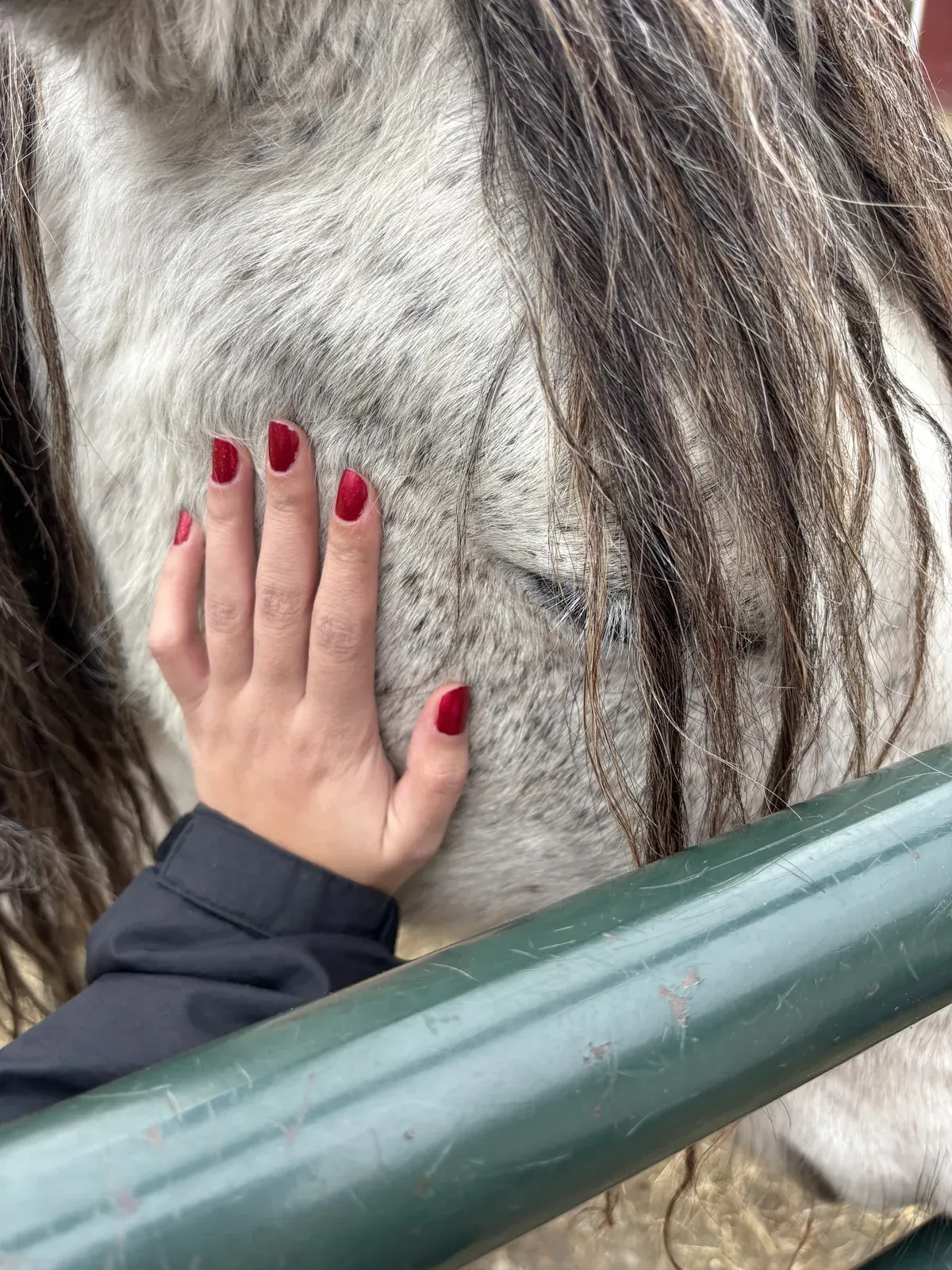
The reasonable first question about equine-assisted therapy is why. Therapy works in a room with two people in it, and adding a thousand pound animal appears to complicate the arrangement without obviously improving it. Most descriptions of the practice do not answer that question well, tending toward language about connection and healing that could describe almost anything.
There is a specific answer, and it has nothing to do with horses being gentle or intuitive in any mystical sense. It has to do with what a prey animal is built to notice.
What it is, and what it is not
Two clarifications remove most of the confusion.
It is generally not riding. The large majority of equine-assisted psychotherapy takes place on the ground, with the person and the horse in a shared space. Sessions might involve grooming, leading, approaching, or in many cases simply standing near the animal and noticing what happens. Therapeutic riding exists and is a distinct discipline with its own aims, largely physical and developmental.
It is also not animal-assisted comfort. A therapy dog in a waiting room is present to lower the temperature of a difficult environment, and that is a legitimate and different function. The horse in equine work is not there to soothe anyone. It is frequently the most challenging element in the room, and that is the point.
What a horse actually contributes
A horse is a prey animal weighing between nine hundred and twelve hundred pounds. Its survival strategy for several million years has consisted of continuously reading its environment for threat and responding faster than a predator can close the distance. That job description turns out to have a clinical use.
- It responds to physiology, not presentation.A horse reads posture, breathing rate, muscular tension, and movement quality continuously. It responds to what your body is doing, not to what you are saying about what your body is doing. Someone who reports being fine while braced and shallow-breathing will find the horse responding to the bracing.
- It has no social filter.Much of what happens in a therapy room is filtered through social convention on both sides. A horse has no investment in the interaction going smoothly. It moves away or it does not, and neither response is a judgment.
- The feedback is immediate.There is no delay between a change in your state and a change in the animal's behavior. People who have spent years describing their internal states in the past tense encounter something happening in real time in front of them.
- It cannot be talked out of its response.Difficult to argue with a horse's response, and difficult to reframe it. This closes off a large number of the moves people use to avoid material, which is uncomfortable and useful in roughly equal measure.
The clinical value is that internal states stop being something a person reports and become something visible in the space. For a person who has learned to describe their feelings fluently without actually contacting them, which is an extremely common presentation, this is a fundamentally different situation from a conversation.
What the horse is not doing
It is worth separating the clinical claim from the version of it that circulates in promotional material, because the promotional version is doing real damage to how the practice is received.
The horse is not reading your mind, sensing your aura, or knowing what happened to you. It is not selecting the person in the group who needs it most. Claims along those lines appear regularly and there is nothing behind them, and they make it considerably harder for a skeptical person to take the actual mechanism seriously.
The actual mechanism is less magical and more interesting. An animal whose survival depends on detecting threat is extremely good at reading the physical signals a human body produces under stress, and it responds to them without any of the social softening a person would apply. That is a mundane explanation, and it is sufficient to account for what happens in a session. Nothing further is required.
What a session tends to look like
Sessions vary by model and by clinician, and there is a recognizable shape to them.
- Something is set up.The person and the clinician set a focus. This may be as concrete as a situation at work or as open as noticing what happens.
- A task is introduced.Approaching the horse, leading it, asking it to move, or standing in the enclosure. The task is often almost trivially simple, and the simplicity is deliberate.
- The horse responds.The horse does something. It moves away, it stays, it becomes restless, it drops its head. This is data rather than performance.
- The clinician processes it.The clinician works with what happened. Not interpreting the horse's inner life, which nobody can access, but examining what the person did, what they felt, and what shifted when the animal responded.
The recurring theme is that a task that sounds simple frequently is not. People discover they cannot approach directly, or that they hold their breath the entire time, or that they become intensely frustrated at an animal that has done nothing. Those discoveries arrive fast and they are difficult to dismiss.
What the evidence supports
This literature is younger and thinner than the literature behind established talk-based treatments, and it is worth being straightforward about that rather than overstating it.
- Trials in PTSD, particularly with veteran populations, have found symptom reductions, and some of this work is reasonably well designed. Sample sizes are generally modest.
- Adolescent studies show improvements in emotional regulation and engagement, with the engagement finding being among the more consistent results across the field.
- Anxiety and depression outcomes are mixed, with several positive studies and considerable methodological variability across them.
- Methodology is the field's main weakness. Control conditions are difficult to construct, protocols differ substantially between models, and blinding is impossible. Several reviews have concluded that the practice is promising while calling for stronger designs, which is a fair summary.
The reasonable position is that this is a developing modality with encouraging results in specific populations, not an established first-line treatment. Anyone presenting it as more settled than that is not being accurate.
Who it tends to suit
A few patterns recur. The first is people who intellectualize. Articulate, insightful clients who can describe their difficulties precisely and have not moved in years are common, and they are often the ones for whom something non-verbal changes the picture. The same logic underlies much of the case forsomatic work over talk therapy alone, and the horse is an unusually direct version of it.
The second is people who cannot say what is wrong. Where language is genuinely not available, either because of early trauma or because the material predates verbal memory, a modality that does not depend on narrative has an obvious advantage.
The third is adolescents. A teenager who will not engage in an office will often engage in a paddock. Some of this is simply that it does not feel like therapy, and it is not necessary to be precious about that.
The fourth is people carrying trauma that talk therapy has approached without resolving. This is the population where the trauma evidence is strongest, with the caveat that it is usually an adjunct to clinical work rather than a replacement for it.
Reasonable caution
- Physical safety is a genuine consideration. Horses are large and can injure people. Appropriate facilities, trained handlers, and a clear safety protocol are not optional and are a fair thing to ask about.
- Credentialing in this field is inconsistent. There are several certifying bodies with different standards, and the term equine therapy is not protected. Ask what the clinical license is, separately from the equine credential.
- A serious fear of horses is not automatically disqualifying and it does change the work substantially. It should be discussed before a first session rather than discovered during one.
- This is generally not covered by insurance and it is not inexpensive. That is worth knowing before rather than after.
Frequently Asked Questions
Do I need to know anything about horses?
No, and having no experience is frequently an advantage. People with riding backgrounds sometimes bring a set of technical habits that get in the way of noticing what is actually happening between them and the animal.
Is it safe if I am nervous around horses?
Generally yes, with the right structure. A good deal of early work can happen outside the enclosure or at a distance, and proximity increases at the pace the person sets. A real phobia should be raised in advance so the session can be designed around it.
Is this therapy or an activity?
It depends entirely on who is running it. Equine-assisted psychotherapy involves a licensed mental health clinician. Equine-assisted learning and therapeutic riding are different things with different aims and different training behind them. Asking directly which one is on offer is a reasonable question and a good practitioner will welcome it.
How many sessions does it take?
Most protocols in the research run six to twelve sessions. In practice it is often used as a component of a broader course of work rather than as a standalone treatment with a fixed endpoint.
Will insurance cover it?
Usually not. Coverage for equine-assisted work is uncommon regardless of the clinician's license, and it should be treated as a private-pay service when you are planning for it.
If Talking Has Not Been Enough
The people who ask about equine work are rarely looking for something novel. They are usually people who have done a considerable amount of therapy, can explain their own patterns better than most clinicians could, and have not moved. That is a specific problem and it responds to a specific kind of intervention.
The free 15 minute discovery call is a conversation, not an intake. Tell us what you have already tried and where it stopped being useful, and we will help you work out whether this is a reasonable direction or whether something else fits better. If what you describe needs a level of care beyond what we provide, we will say so and point you toward it.
Call(201) 708-8448orbook your free discovery call. We are at 96 East Allendale Road in Saddle River, and we see clients across Bergen County in person and throughout New Jersey by video.
This blog post is for informational purposes only and does not constitute professional mental health advice, diagnosis, or treatment.
Not sure if this is right for you? Take the 30-second match.